Appendicitis Pain Location: Is Your Stomach Pain an Emergency?

The appendix is a small finger-shaped pouch connected to the cecum, which is part of the large intestine located in the lower right side of the abdomen. When the appendix becomes blocked and inflamed, pain often develops gradually rather than suddenly. One reason appendicitis can be difficult to recognize early is because the discomfort changes location and intensity over time.
For many patients, the pain follows a predictable pattern known as the “classic migration” of appendicitis pain. It typically begins near the center of the abdomen before moving toward the lower right side as inflammation spreads. Understanding these stages may help people distinguish appendicitis from temporary digestive issues such as gas, bloating, or food poisoning.
Stage 1: The Vague Ache Near the Belly Button (Periumbilical Pain)
In the earliest stage, appendicitis often causes a dull, poorly localized ache around the belly button area. Doctors refer to this as periumbilical pain. At this point, the discomfort usually feels vague and difficult to pinpoint exactly. Many people describe it as a strange pressure, mild cramping sensation, or an uncomfortable “fullness” in the center of the stomach.
Unlike sudden severe abdominal pain, early appendix pain may seem mild enough to ignore. Some people continue normal daily activities for several hours before realizing the discomfort is becoming more persistent. Because the pain is not yet concentrated in the lower right abdomen, it is commonly mistaken for:
- Mild indigestion
- Gas pain
- Viral stomach illness
- Menstrual cramps
- Constipation
- Muscle strain
- General stomach upset
This early pain occurs because the inflamed appendix initially irritates nerves connected to the mid-abdominal region rather than the outer abdominal lining. During this phase, symptoms may also include loss of appetite, mild nausea, bloating, or a general feeling of being unwell.
One important detail is that the pain often does not improve after passing gas, resting, or using the bathroom. Instead, the discomfort slowly intensifies over time. Patients may notice that eating becomes less appealing, and some begin experiencing mild nausea even before sharper pain develops.
For children and older adults, this early stage can be especially difficult to recognize because symptoms may appear subtle or atypical. Some patients simply report feeling “off” or unusually fatigued before the classic pain migration occurs.
Stage 2: The Migration to the Lower Right Abdomen (McBurney’s Point)
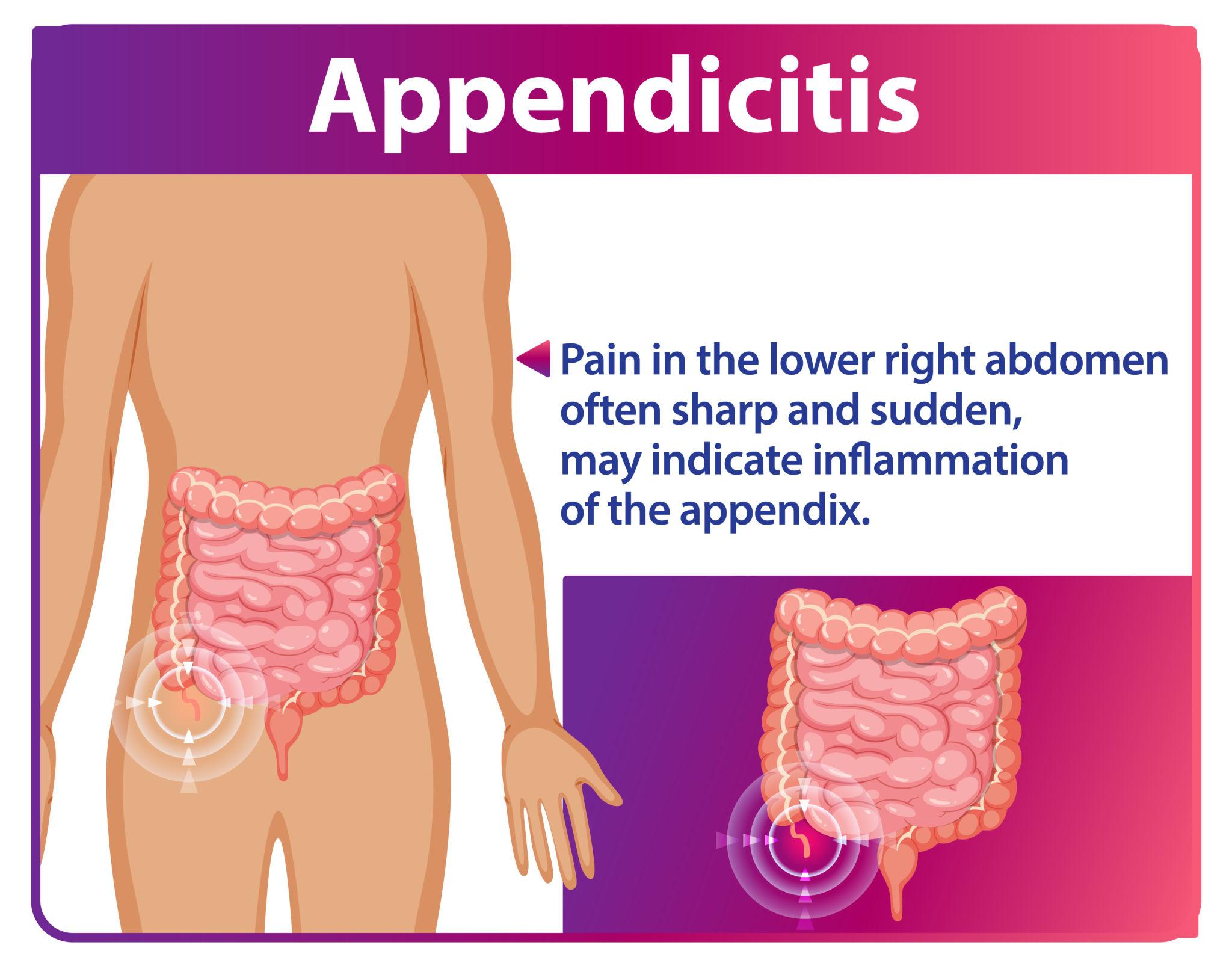
As the inflammation worsens, the pain typically begins moving away from the belly button and toward the lower right side of the abdomen. This shift is considered one of the hallmark signs of appendicitis.
The most common location is known as McBurney’s point, an area roughly halfway between the belly button and the right hip bone. Once the pain reaches this region, it often becomes sharper, more localized, and easier to identify with one finger.
At this stage, many patients notice a clear difference in the quality of pain. What started as a dull ache may now feel stabbing, burning, or intensely tender. Even gentle pressure over the area can become uncomfortable. Some people instinctively guard the right side of their abdomen or avoid standing fully upright because stretching the abdominal muscles increases discomfort.
The movement of pain occurs because the inflammation is spreading from the appendix itself to the surrounding peritoneum, the thin tissue lining the abdominal cavity. When the peritoneum becomes irritated, the brain can identify the pain location more precisely.
Doctors often focus on McBurney’s point during physical examinations because tenderness there is strongly associated with acute appendicitis. Additional clinical signs may also appear, including:
- Rovsing’s sign — pressing on the left side of the abdomen causes pain on the right side
- Psoas sign — pain increases when lifting or extending the right leg
- Obturator sign — internal rotation of the hip triggers pelvic pain
Some patients also begin developing a mild fever during this phase, along with worsening nausea or occasional vomiting. Appetite loss often becomes more pronounced as inflammation increases.
Stage 3: Sharp, Localized Pain That Worsens with Movement
As appendicitis progresses further, the pain usually becomes more severe, concentrated, and difficult to ignore. At this stage, inflammation may significantly irritate the peritoneum, causing movement-related pain that feels sharp or jarring.
Patients commonly report that the pain worsens dramatically during activities such as:
- Walking
- Coughing
- Sneezing
- Laughing
- Taking deep breaths
- Climbing stairs
- Riding over bumps in a car
- Sudden body movements
Even small motions can trigger intense discomfort because movement shifts the inflamed tissues inside the abdomen. Some individuals walk slowly while leaning forward slightly in an attempt to reduce tension on the abdominal wall.
The abdomen may also become increasingly tender to touch. In some cases, muscles tighten automatically to protect the inflamed area, creating a sensation of abdominal guarding or rigidity.
As inflammation continues, additional symptoms may appear, including:
- Fever
- Chills
- Vomiting
- Constipation or diarrhea
- Inability to pass gas
- Increasing abdominal swelling
If the appendix ruptures, the pain pattern can temporarily change. Some patients experience a brief reduction in pain before symptoms rapidly worsen again as infection spreads throughout the abdominal cavity. This can lead to a serious condition called peritonitis, which requires emergency medical care.
Because appendicitis symptoms can overlap with many other digestive conditions, doctors may use blood tests to look for leukocytosis (high white blood cell count), along with imaging studies such as ultrasound or CT scan to confirm the diagnosis.
What Does Appendicitis Pain Feel Like? (Patient Experience)
People describe appendix pain in many different ways, but several patterns appear consistently among patients diagnosed with appendicitis. In the early stages, the discomfort is often mild and easy to dismiss. However, as inflammation worsens, the pain usually becomes more intense, more localized, and harder to ignore.
Many patients initially report a dull abdominal ache that slowly intensifies over several hours. Instead of a sudden sharp pain, the sensation often begins as vague discomfort in the middle of the abdomen. Some people describe it as pressure, bloating, heaviness, or a feeling that “something isn’t right” inside the stomach.
As the inflammation progresses and spreads toward the abdominal lining, the pain often changes character. The dull ache may evolve into a sharper, stabbing pain concentrated in the lower right abdomen. At this point, the discomfort usually becomes more constant rather than coming and going in waves.
Some common descriptions include:
- A dull abdominal ache that gradually intensifies
- Sharp stabbing pain in the lower right abdomen
- A pulling or tearing sensation during movement
- Cramping that becomes steadily more severe
- Pain that feels deep inside the abdomen
- Tenderness that worsens when touched
- Constant pain that does not improve with rest
Unlike ordinary gas pain or indigestion, appendicitis discomfort usually does not improve after using the bathroom, passing gas, or changing position. Instead, many patients notice the pain becoming progressively worse throughout the day.
One important feature associated with appendicitis is called rebound tenderness. This occurs when pain becomes significantly worse after pressure is quickly released from the abdomen rather than during the pressure itself. Doctors often check for this sign during a physical examination because it may indicate irritation of the peritoneum, the thin lining surrounding abdominal organs.
Movement-related pain is also extremely common. Activities that gently shake or stretch the abdomen may suddenly become painful. Patients frequently report worsening pain during:
- Walking
- Coughing
- Sneezing
- Laughing
- Climbing stairs
- Riding over bumps in a car
- Taking deep breaths
- Standing upright too quickly
Because movement aggravates the inflamed tissues, some individuals begin walking slowly or bending slightly forward to reduce abdominal tension. Children with appendicitis may refuse to run, jump, or even stand normally because movement feels too uncomfortable.
In addition to abdominal pain, many patients experience other symptoms as inflammation worsens. These symptoms may appear gradually or occur alongside the pain itself.
Common accompanying symptoms include:
- Loss of appetite
- Nausea
- Vomiting
- Low-grade fever
- Bloating
- Constipation
- Diarrhea
- Fatigue
- General malaise or weakness
A loss of appetite is considered one of the most common early symptoms. Some people notice they suddenly have no interest in food, even before severe pain develops.
The severity of pain does not always perfectly match the seriousness of appendicitis. Older adults, young children, pregnant individuals, and people with atypical appendix positions may experience less obvious symptoms. In these cases, diagnosis can sometimes be delayed because the pain pattern appears unusual.
If inflammation continues untreated, the pain may become extremely severe and spread across the abdomen, particularly if the appendix ruptures. A burst appendix can release bacteria into the abdominal cavity, potentially leading to a dangerous infection called peritonitis.
Because appendicitis symptoms overlap with many other digestive conditions, doctors may use blood tests to look for leukocytosis (high white blood cell count), along with imaging studies such as ultrasound or CT scan to confirm the diagnosis.
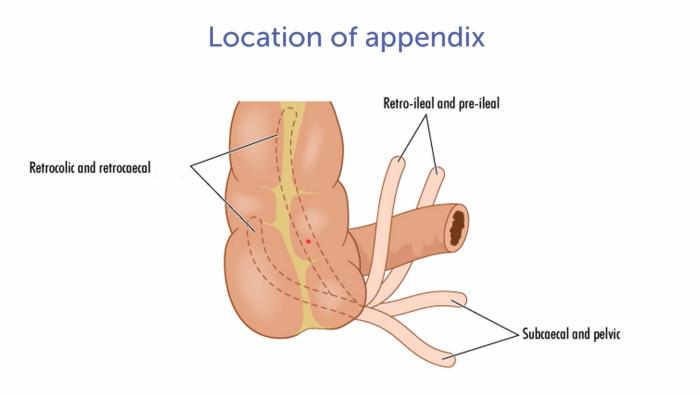
Atypical Locations: When the Pain Isn’t Where You Expect
Not every appendix sits in the exact same anatomical position. While many people develop classic pain in the lower right abdomen, others experience discomfort in unexpected areas because the appendix can vary naturally in location. These anatomical differences can create confusing symptoms that resemble kidney problems, bladder infections, muscle strain, or gynecological conditions.
This is one reason appendicitis may sometimes be difficult to diagnose early. Atypical appendicitis pain can delay medical evaluation because patients often assume the pain is coming from another organ or condition.
Retrocecal Appendix: Pain in the Lower Back or Flank
A retrocecal appendix is positioned behind the cecum, the beginning of the large intestine. This is one of the most common anatomical variations of the appendix.
Because the appendix sits farther behind the abdominal wall, inflammation may irritate deeper tissues instead of the front abdominal lining. As a result, patients may not experience the classic sharp pain at McBurney’s point.
Instead, discomfort may appear in areas such as:
- The lower back
- The right flank
- The side of the abdomen
- The hip region
Some people describe the pain as a deep ache rather than surface tenderness. Others feel discomfort primarily during movement, walking, or stretching the right leg.
Because the symptoms overlap with other conditions, retrocecal appendicitis is sometimes mistaken for:
- Kidney stones
- Muscle strain
- Sciatica
- Urinary tract infection
- Lower back injury
Patients may also have less obvious abdominal tenderness during physical examination, making diagnosis more challenging. In some cases, doctors rely more heavily on imaging such as CT scan or ultrasound when symptoms are atypical.

Pelvic Appendix: Pain near the Rectum or Bladder
In some individuals, the appendix hangs lower into the pelvic cavity. This is known as a pelvic appendix.
When inflammation develops in this position, symptoms may affect nearby pelvic organs rather than the upper abdominal lining. Instead of sharp right-sided abdominal pain, patients may experience:
- Pelvic pressure
- Rectal discomfort
- Pain during urination
- Frequent urge to urinate
- Pain during bowel movements
- Lower pelvic cramping
Because the inflamed appendix sits close to the bladder or rectum, some patients mistakenly believe they have a urinary or gynecological problem rather than appendicitis.
In women especially, pelvic appendicitis may resemble:
- Pelvic Inflammatory Disease (PID)
- Ovarian cysts
- Endometriosis
- Menstrual cramps
- Urinary tract infection
Doctors sometimes perform pelvic examinations, urine testing, ultrasound, or CT imaging to help distinguish these conditions from appendicitis.
Pregnancy & Appendicitis: Why the Pain Might Be in the Upper Right Quadrant
Pregnancy can significantly change the location of appendix pain. As the uterus expands, it gradually pushes abdominal organs upward, including the appendix itself.
Because of this shift, pregnant individuals may not feel pain near McBurney’s point at all. Instead, discomfort may occur:
- Higher on the right side of the abdomen
- Near the ribs
- In the upper right quadrant
- Along the side of the abdomen
This altered pain pattern can make appendicitis more difficult to recognize during pregnancy, especially because symptoms such as nausea, bloating, and mild abdominal discomfort are already common in pregnancy.
In some cases, diagnosis may be delayed because the pain resembles:
- Gallbladder disease
- Acid reflux
- Muscle stretching
- Pregnancy-related abdominal discomfort
Doctors often use ultrasound or MRI imaging during pregnancy to evaluate abdominal pain while minimizing radiation exposure.
Prompt medical assessment remains important because untreated appendicitis during pregnancy may increase the risk of complications for both the pregnant individual and the fetus.
Conclusion
Understanding the typical appendicitis pain location may help people recognize when abdominal discomfort could signal a medical emergency rather than a minor digestive problem. Although appendicitis is commonly associated with sharp pain in the lower right abdomen, the condition often begins much more subtly. In many cases, the pain starts as a vague ache around the belly button before gradually migrating downward and becoming more intense as inflammation spreads.
However, not every person experiences the “classic” pattern of appendicitis symptoms. The exact location and severity of pain can vary depending on the position of the appendix, the patient’s age, pregnancy status, and other underlying health conditions. Some individuals may feel discomfort in the lower back, pelvis, flank, or even the upper abdomen instead of the right lower quadrant. Because of these atypical presentations, appendicitis can sometimes be mistaken for gas pain, kidney stones, food poisoning, urinary tract infections, menstrual cramps, or other gastrointestinal conditions.
One of the most important warning signs is pain that steadily worsens over time rather than improving. Persistent abdominal pain accompanied by symptoms such as fever, nausea, vomiting, loss of appetite, rebound tenderness, bloating, or pain that worsens during walking and coughing should never be ignored. These symptoms may indicate increasing inflammation or, in severe cases, a ruptured appendix.
A burst appendix can allow bacteria and infected material to spread throughout the abdominal cavity, potentially leading to peritonitis, a serious and potentially life-threatening infection. In some cases, the pain may briefly decrease after rupture before rapidly worsening again as infection spreads. This temporary relief can create a dangerous false sense of improvement.
Because appendicitis symptoms can overlap with many other conditions, healthcare providers often rely on a combination of physical examination, blood testing for leukocytosis (high white blood cell count), imaging studies such as ultrasound or CT scan, and careful symptom evaluation to make an accurate diagnosis. Early medical assessment can help reduce the risk of complications and improve treatment outcomes.
Ultimately, persistent or worsening abdominal pain should always be taken seriously — especially when the pain becomes localized, movement-related, or associated with fever and digestive symptoms. While not every stomach ache is appendicitis, recognizing the early signs and understanding how appendix pain typically progresses may help people seek timely medical attention before complications develop.