Autoimmune Thyroiditis: Causes, Symptoms, and Science-Backed Treatment Options
What Is Autoimmune Thyroiditis? A Deep Dive Into the Condition That Quietly Changes Everything
Autoimmune thyroiditis is a term that encompasses a group of inflammatory thyroid conditions in which the body's own immune system becomes the primary agent of damage to the thyroid gland. It is chronic, often silent in its early stages, and remarkably common — yet it continues to go unrecognized in a significant proportion of those affected. For many patients, years pass between the onset of symptoms and a correct diagnosis, during which time the thyroid is being progressively compromised.
This article explores autoimmune thyroiditis in comprehensive detail: its mechanisms, its clinical stages, the many ways it presents in different individuals, how it is diagnosed and monitored, and the full spectrum of treatment approaches — from conventional medicine to the emerging role of nutrition, microbiome health, and functional medicine strategies.
Defining Autoimmune Thyroiditis: Types and Terminology
The term "autoimmune thyroiditis" refers to any thyroiditis — inflammation of the thyroid — that is caused by immune-mediated mechanisms. In clinical practice, this most commonly means one of the following conditions:
Hashimoto's thyroiditis (chronic autoimmune thyroiditis): The most common form, characterized by a gradual immune-mediated destruction of thyroid tissue, leading to hypothyroidism. Defined by the presence of anti-TPO and/or anti-thyroglobulin antibodies, lymphocytic infiltration of the thyroid on histology, and often a characteristic appearance on ultrasound.
Silent (painless) thyroiditis: A transient form of autoimmune thyroiditis that typically follows a triphasic course — hyperthyroid, hypothyroid, then euthyroid — resolving on its own in most cases. Antibodies may be transiently elevated. It is considered part of the same spectrum as postpartum thyroiditis.
Postpartum thyroiditis: A variant of silent thyroiditis occurring within the first year after childbirth, miscarriage, or termination of pregnancy. Occurs in approximately 5–10% of women and is significantly more common in those with pre-existing thyroid antibodies.
Fibrous variant of Hashimoto's: A less common but important variant in which thyroid tissue is replaced by extensive fibrosis, sometimes mimicking thyroid cancer on imaging. Important to recognize to avoid unnecessary surgery.

The Inflammatory Cascade: How Autoimmune Thyroiditis Damages the Gland
At the cellular level, autoimmune thyroiditis begins with the activation of autoreactive T lymphocytes — T cells that recognize thyroid-specific antigens as foreign. Under normal circumstances, these cells should have been eliminated during thymic development. When they escape this elimination and are activated by environmental triggers, they infiltrate the thyroid gland and initiate a local inflammatory response.
Within the thyroid, these T cells recruit additional immune cells — including B lymphocytes, natural killer cells, and macrophages — creating a chronic inflammatory infiltrate. The B lymphocytes produce the characteristic antibodies: anti-thyroid peroxidase (anti-TPO) and anti-thyroglobulin (anti-Tg). While these antibodies are not directly responsible for all the damage, they amplify the inflammatory response and serve as excellent biomarkers of the autoimmune process.
Over time, the chronic inflammation leads to progressive destruction of thyroid follicular cells (thyrocytes). The thyroid tries to compensate through hypertrophy and proliferation of remaining cells, but ultimately the destructive process outpaces regeneration. As the follicular cell mass decreases, the thyroid's capacity to produce adequate T4 and T3 diminishes. The pituitary gland responds by increasing TSH output, which initially may maintain normal thyroid hormone levels (subclinical hypothyroidism), but eventually the gland can no longer keep pace and overt hypothyroidism develops.
Clinical Stages of Autoimmune Thyroiditis
Autoimmune thyroiditis is not a static disease — it progresses through recognizable stages, though the pace of progression varies widely between individuals.
Stage 1 — Euthyroid with positive antibodies: The earliest detectable stage. Thyroid function tests are completely normal, but anti-TPO and/or anti-Tg antibodies are elevated. The person may feel entirely well. Many people remain in this stage for years without progressing to frank thyroid dysfunction. However, the risk of eventual hypothyroidism is significantly elevated, estimated at approximately 2–5% per year.
Stage 2 — Subclinical hypothyroidism: TSH begins to rise above the normal range (typically 4.5–10 mIU/L), but free T4 remains within normal limits. The pituitary is compensating for decreasing thyroid reserve. Symptoms may or may not be present. Controversy exists about whether and when to treat at this stage.
Stage 3 — Overt hypothyroidism: TSH is markedly elevated (often above 10 mIU/L) and free T4 is below the normal range. Classic hypothyroid symptoms become prominent. Treatment with thyroid hormone replacement is clearly indicated.
Hashitoxicosis (transient): Some patients experience an initial hyperthyroid phase when inflammatory destruction releases stored thyroid hormone into the circulation. This is typically short-lived and does not require antithyroid drugs, though beta-blockers may be used for symptom relief.
The Symptom Burden of Autoimmune Thyroiditis
The symptoms of autoimmune thyroiditis span multiple organ systems and can vary considerably in severity. What makes this disease particularly challenging is that many of its symptoms are non-specific and overlap with common conditions such as depression, chronic fatigue syndrome, fibromyalgia, and anemia — leading to frequent misdiagnosis or dismissal.
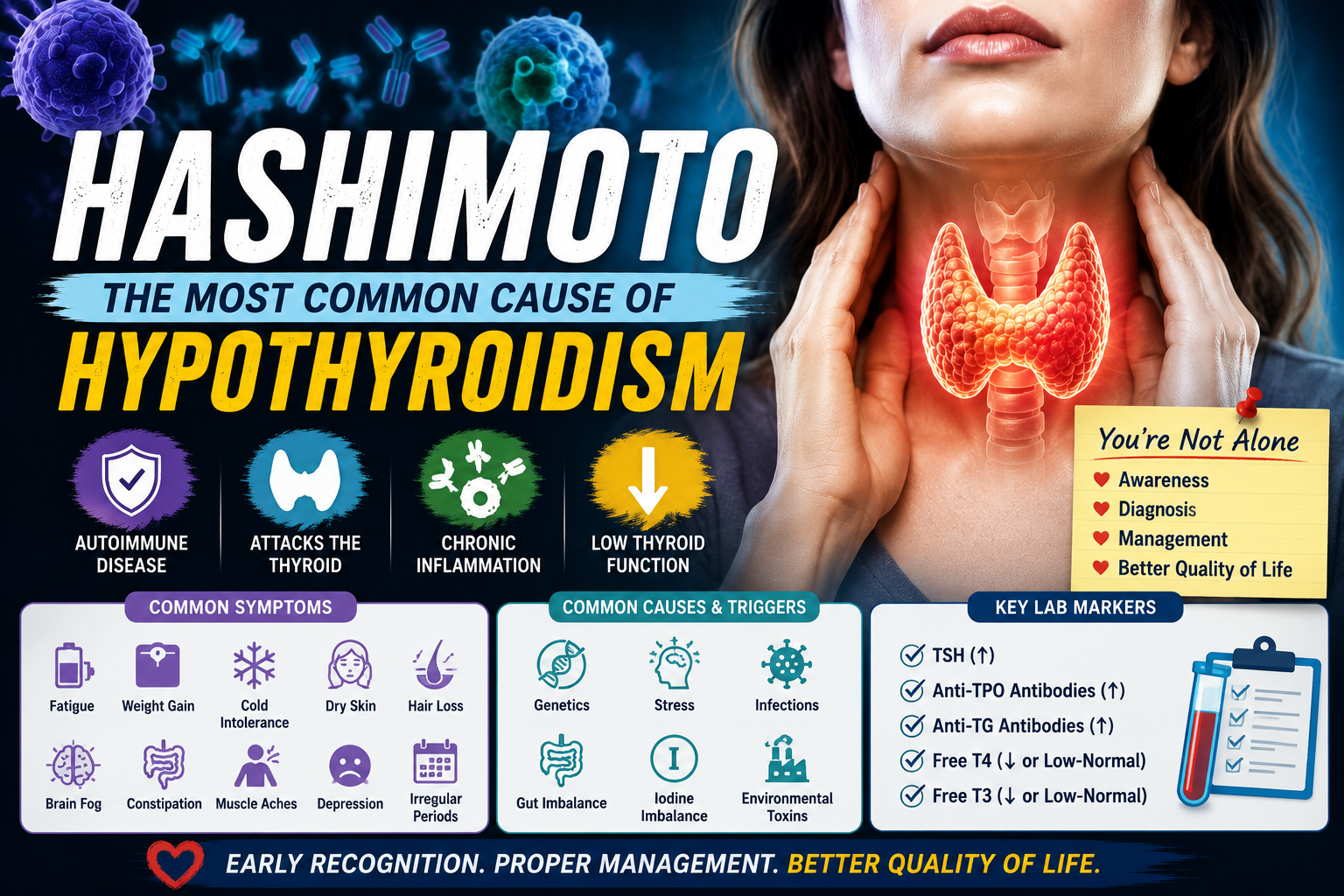
The classic hypothyroid symptoms include profound fatigue and lack of energy even after adequate sleep; weight gain that is resistant to dietary changes; cold intolerance — feeling cold when others are comfortable; dry, rough skin and hair that becomes coarse, brittle, or falls out; constipation; slowed heart rate; fluid retention causing puffiness of the face, especially around the eyes; depression and emotional flatness; memory problems and difficulty concentrating (brain fog); muscle aches, stiffness, and weakness; heavy, irregular, or painful menstrual periods; and reduced libido.
Importantly, symptoms do not always correlate neatly with TSH levels. Some patients have profound symptoms with only mildly abnormal labs, while others with markedly elevated TSH may have few or no complaints. This individual variability is one of the most important reasons to treat the patient rather than simply the test result.

Diagnosis: Getting It Right From the Start
The diagnostic workup for autoimmune thyroiditis should be thorough and systematic. A proper evaluation begins with a detailed medical history, including personal and family history of autoimmune conditions, recent pregnancy or illness, medication use, and symptom timeline. This is followed by physical examination, including palpation of the thyroid gland (which may be enlarged, nodular, or atrophied in autoimmune thyroiditis).
Laboratory testing should include: TSH (the most sensitive indicator of thyroid status), free T4 and free T3 for a complete hormonal picture, anti-TPO antibodies (positive in 90–95% of Hashimoto's cases), anti-thyroglobulin antibodies (positive in 60–80% of cases, and sometimes the only positive antibody in seronegative Hashimoto's), complete blood count to check for anemia (common in hypothyroidism), comprehensive metabolic panel, ferritin, vitamin B12, vitamin D, and in selected cases, screening for celiac disease (anti-tTG IgA antibody).
Thyroid ultrasound is increasingly considered a standard part of the initial evaluation. In Hashimoto's thyroiditis, the gland characteristically shows reduced echogenicity (appears darker than normal), a heterogeneous or "moth-eaten" texture, and often fibrous stranding. The gland may be enlarged (in early stages) or atrophied (in advanced disease). Ultrasound can also detect nodules, which require additional evaluation to exclude malignancy — an important consideration since thyroid lymphoma (though rare) has a higher incidence in Hashimoto's patients.
Conventional Treatment: What Works and What's Still Debated
For patients with overt hypothyroidism due to autoimmune thyroiditis, levothyroxine (synthetic T4) replacement remains the standard of care and is highly effective in most cases. The goal of treatment is to normalize TSH and relieve symptoms. Dosing is highly individualized, typically starting at 25–50 mcg/day and adjusted based on regular TSH monitoring.
The management of subclinical hypothyroidism is more nuanced. Current guidelines generally recommend treatment when TSH exceeds 10 mIU/L, when symptoms are present and attributable to thyroid dysfunction, in pregnant women or those planning pregnancy (where optimal thyroid function is critical for fetal development), and in patients with cardiovascular risk factors. For TSH values between 4.5 and 10 mIU/L in asymptomatic individuals, a watchful waiting approach with periodic monitoring is often adopted.
For patients who remain symptomatic despite optimal levothyroxine dosing and normalized TSH, the addition of liothyronine (T3) — either as a separate medication or as combination T4/T3 — is an option increasingly considered in specialist practice. Some patients with a specific genetic variant in the DIO2 gene (which encodes a deiodinase enzyme involved in T4-to-T3 conversion) may benefit particularly from this approach.
Emerging and Complementary Approaches
The field of autoimmune thyroiditis management is evolving rapidly, with growing evidence for several complementary approaches. Selenium supplementation at doses of 100–200 mcg daily has been shown in multiple randomized controlled trials to reduce anti-TPO antibody titers and improve well-being in Hashimoto's patients, with an excellent safety profile at these doses. Inositol, particularly myo-inositol in combination with selenium, has shown promising results in preliminary studies for both reducing antibody levels and improving thyroid function.
Dietary interventions are widely discussed in the autoimmune thyroiditis community. An autoimmune protocol (AIP) diet — a stricter variation of a paleo diet that eliminates grains, legumes, dairy, eggs, nightshades, and other potentially inflammatory foods — has gained popularity, though rigorous clinical trial evidence remains limited. Gluten elimination deserves special mention given the documented association between Hashimoto's and celiac disease, and some non-celiac patients also report improvement with gluten-free eating.
Low-dose naltrexone (LDN) is an off-label treatment generating considerable interest in the autoimmune community. At doses of 1.5–4.5 mg/day (far below the standard addiction-treatment dose of 50 mg), naltrexone appears to modulate immune function through effects on opioid receptors and microglial activity. While evidence in autoimmune thyroiditis specifically is still accumulating, reports from clinical practice and preliminary studies are encouraging.
Living With Autoimmune Thyroiditis: Practical Strategies
Managing autoimmune thyroiditis effectively requires more than medication — it requires a comprehensive lifestyle strategy. Sleep optimization is critical, as poor sleep impairs immune regulation and worsens inflammatory conditions. Stress management is equally important: chronic psychological stress activates the HPA axis, elevates cortisol, and promotes immune dysregulation. Practices such as meditation, yoga, tai chi, and cognitive-behavioral therapy have all demonstrated measurable benefits on inflammatory markers.
Regular moderate exercise is beneficial, but very intense exercise — particularly in the setting of poorly controlled thyroid disease — can be counterproductive. Starting gently and building gradually, with attention to recovery, is the recommended approach. Environmental toxin reduction — minimizing exposure to endocrine disruptors like BPA, phthalates, pesticides, and certain food additives — is increasingly recognized as potentially beneficial, though the evidence base is still developing.
Perhaps most importantly, people with autoimmune thyroiditis benefit enormously from being well-informed about their condition. Patients who understand the disease, know what to watch for, can interpret their own lab results, and advocate effectively within the healthcare system consistently report better quality of life and outcomes than those who remain passive recipients of care.