Female Bowel Obstruction Symptoms: What Women Need to Know
2026-05-119 views5 min read
Female Bowel Obstruction Symptoms: What Women Need to Know
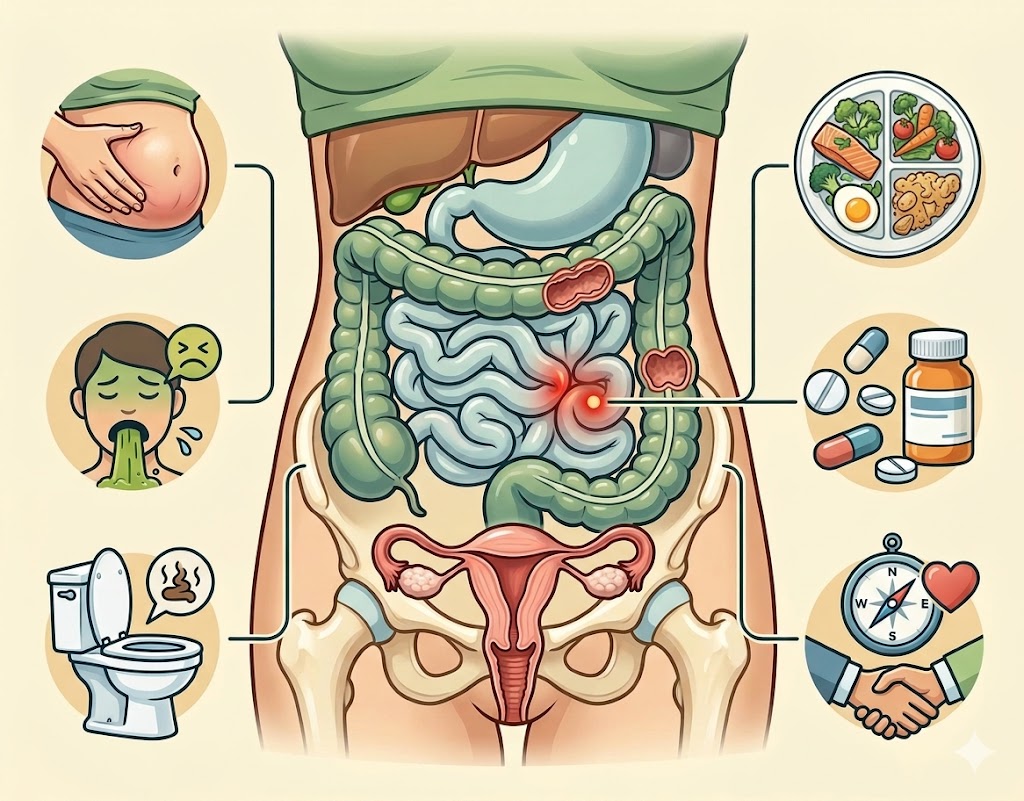
Bowel obstruction can affect anyone, regardless of age or gender. But for women, the experience of a bowel obstruction comes with a unique layer of complexity: many of the symptoms overlap significantly with gynecological conditions — ovarian cysts, endometriosis, pelvic inflammatory disease, ectopic pregnancy, and uterine fibroids. This overlap can lead to delayed diagnosis, misattribution of symptoms, and, in some cases, dangerous delays in treatment.
This guide is specifically written for women and those caring for women. It covers the standard symptoms of bowel obstruction as they commonly present in females, the gynecological conditions that can look almost identical, the female-specific risk factors that raise the likelihood of obstruction, and the critical signs that mean it is time to go to the emergency room.
How Bowel Obstruction Affects Women: An Overview
The fundamental biology of bowel obstruction is the same regardless of gender — something physically blocks or functionally disrupts the flow of intestinal contents through the small or large intestine. However, several factors make bowel obstruction both more common and more diagnostically complex in women:
Pelvic surgeries: Women undergo pelvic and abdominal surgeries at high rates — cesarean sections, hysterectomies, ovarian cyst removals, appendectomies, and surgeries for endometriosis or fibroids. Each of these surgeries creates scar tissue (adhesions), and adhesions are the number one cause of small bowel obstruction.
Endometriosis: This condition, in which uterine-like tissue grows outside the uterus, can involve the bowel directly. Bowel endometriosis can cause progressive narrowing of the intestinal lumen, ultimately leading to obstruction. It also causes symptoms that closely mimic obstruction even without causing a true block.
Ovarian and gynecological tumors: Ovarian cancer, particularly in advanced stages, is a common cause of malignant bowel obstruction in women. Large ovarian cysts or tumors can also compress the bowel externally, causing obstruction.
Pelvic inflammatory disease (PID): Severe or recurrent PID can cause pelvic adhesions involving the bowel.
Core Symptoms of Bowel Obstruction in Women
The primary symptoms of bowel obstruction are present regardless of gender, but their perceived location, character, and associated symptoms may differ in women due to the proximity of the reproductive organs.
Abdominal and Pelvic Pain
In women, bowel obstruction pain can be felt in the lower abdomen and pelvis — areas that overlap completely with gynecological pain. The pain of bowel obstruction is typically colicky (coming in waves, peaking, then briefly easing) in the early stages, transitioning to constant and severe if the obstruction worsens or complications develop.
Women with bowel obstruction often report:
- Crampy pain that is initially confused with menstrual cramps or ovulation pain
- Lower abdominal pressure or fullness that feels gynecological in origin
- Pain that does not follow a typical menstrual pattern (occurring outside the expected cycle)
- Rapid escalation of intensity beyond what typical menstrual pain feels like
Key distinguishing features from menstrual pain: bowel obstruction pain does not respond to typical menstrual pain remedies (NSAIDs, heating pads), is associated with digestive symptoms (nausea, vomiting, constipation), and tends to progressively worsen rather than fluctuate with the menstrual cycle.
Nausea and Vomiting
Nausea and vomiting are prominent features of bowel obstruction in women, just as in men. However, women may initially attribute these symptoms to morning sickness (if pregnancy is possible), food intolerance, or a stomach virus.
Red flags that nausea and vomiting are NOT ordinary:
- Unrelenting nausea that does not improve with rest, food, or antiemetics
- Vomiting that becomes progressively worse over hours
- Vomiting with a bile-colored or foul, feculent odor
- Vomiting accompanied by inability to pass gas or stool
- Vomiting that occurs alongside rapidly worsening abdominal pain
Abdominal Distension
The abdomen may become visibly and palpably swollen as gas and fluid accumulate behind the blockage. Women may describe this as feeling "bloated" — a sensation they may have experienced before with PMS or IBS. However, obstruction-related distension is different:
- It is progressive and worsening, not cyclical
- It does not resolve with gas or bowel movements
- The abdomen may feel tight and drum-like when tapped
- It is often accompanied by significant discomfort rather than just fullness
Inability to Pass Gas or Have a Bowel Movement
One of the most telling signs in any patient — male or female — is the inability to pass gas (flatus) or stool for more than 24 hours. In women, this symptom may be noticed later if they tend to have irregular bowel habits or attribute constipation to diet, stress, or hormonal changes.
Complete obstipation (inability to pass any stool or gas) in the setting of abdominal pain, nausea, and distension is a critical warning sign that demands emergency evaluation.
Changes in Bowel Habits Preceding Obstruction
Before complete obstruction develops, many women notice a period of progressive constipation or change in stool caliber. Ribbon-like or pencil-thin stools can indicate a narrowing of the colon lumen and should never be dismissed.
Women with known colorectal cancer risk factors, a history of colon polyps, a family history of colon cancer, or age over 50 who develop new changes in bowel habits should seek evaluation promptly.
Gynecological Conditions That Mimic Bowel Obstruction
Several gynecological conditions share symptoms with bowel obstruction so closely that even experienced clinicians can initially confuse them.
Endometriosis
Endometriosis affects 10-15% of women of reproductive age and is one of the most common conditions mistaken for bowel obstruction — and vice versa. Intestinal endometriosis can directly involve the bowel wall, causing symptoms that include:
- Cyclical abdominal and pelvic pain (often worsening before and during menstruation)
- Nausea and vomiting, especially during menstruation
- Bowel pain with defecation (dyschezia)
- Constipation or diarrhea around menstruation
- Rectal bleeding during menstruation in some cases
When endometriosis progresses to cause significant bowel wall fibrosis and narrowing, it can cause recurrent partial bowel obstructions — episodes of obstruction symptoms that partially resolve and recur, often correlating with menstruation.
Unlike simple bowel obstruction, endometriosis-related symptoms are typically cyclical (linked to the menstrual cycle), though this pattern may become less clear as disease progresses.
Ovarian Cysts and Ovarian Torsion
Large ovarian cysts can press against the adjacent bowel, causing symptoms that mimic obstruction including abdominal pain, nausea, bloating, and altered bowel habits. Ovarian torsion (twisting of an ovary) causes sudden, severe lower abdominal pain with vomiting — a presentation that can be confused with the acute pain of bowel obstruction with strangulation.
Key distinguishing feature: ovarian torsion pain is typically more abrupt in onset and may be one-sided, while bowel obstruction pain tends to be more diffuse and centrally located.
Pelvic Inflammatory Disease (PID)
PID causes lower abdominal pain, fever, nausea, and vomiting — all symptoms shared with bowel obstruction. A pelvic examination typically reveals cervical motion tenderness and adnexal tenderness that are characteristic of PID and not of bowel obstruction.
Ectopic Pregnancy
An ectopic pregnancy (a pregnancy implanted outside the uterus, usually in a fallopian tube) can cause severe lower abdominal pain and vomiting. Rupture of an ectopic pregnancy is a life-threatening emergency causing severe pain, internal bleeding, and shock — symptoms that can occasionally be confused with perforated bowel obstruction. A pregnancy test is essential in any woman of reproductive age presenting with acute abdominal symptoms.
Uterine Fibroids
Large uterine fibroids can press on the sigmoid colon or rectum, causing constipation, pelvic pressure, and altered bowel habits. They do not typically cause the acute obstructive symptoms of true bowel obstruction but can contribute to a clinical picture that complicates diagnosis.
Female-Specific Causes of Bowel Obstruction
Beyond the general causes that affect all genders, women have specific causes that either exclusively affect them or affect them disproportionately:
Adhesions from Pelvic Surgery
This is the most important female-specific cause. Women who have undergone cesarean section, hysterectomy, myomectomy (fibroid removal), oophorectomy (ovary removal), or surgeries for endometriosis or ovarian cancer are at substantially elevated risk for adhesion formation and subsequent bowel obstruction. The risk is cumulative — each additional surgery increases the burden of potential adhesions.
Women who have had prior pelvic surgeries should be particularly alert to the development of obstructive symptoms and should inform emergency providers of their surgical history.
Ovarian Cancer and Peritoneal Carcinomatosis
Ovarian cancer is the most common cause of malignant bowel obstruction in women. Advanced ovarian cancer frequently involves the peritoneum (the lining of the abdominal cavity), and peritoneal metastases can cause bowel obstruction by externally compressing or infiltrating the bowel from multiple sites simultaneously. This is called carcinomatosis and represents one of the most challenging clinical scenarios in surgical oncology.
Women with a diagnosis of ovarian cancer who develop progressive constipation, abdominal distension, nausea, or vomiting should seek immediate evaluation.
Bowel Endometriosis
As discussed above, endometriosis directly involving the bowel — particularly the rectosigmoid colon — can cause narrowing of the intestinal lumen severe enough to produce complete obstruction. This is more likely in women with deep infiltrating endometriosis.
Radiation-Induced Stricture
Women who have received pelvic radiation (typically for cervical, uterine, rectal, or bladder cancer) are at long-term risk for radiation-induced injury to the small bowel or colon. This can manifest as strictures (narrowings) that cause intermittent or progressive bowel obstruction, sometimes years to decades after the initial radiation.
Pregnancy-Related Complications
Although rare, bowel obstruction can occur during pregnancy, most commonly due to adhesions from prior surgeries (stimulated by the growing uterus displacing the bowel) or volvulus. Diagnosis is particularly challenging because many symptoms of obstruction overlap with normal pregnancy discomfort, and imaging involves considerations about radiation exposure.
When to Seek Emergency Care: Female-Specific Guidance
Women should seek emergency care immediately if they experience any of the following:
Classic emergency signs present in all patients:
- Severe, constant abdominal pain that does not let up (especially if this represents a change from colicky pain)
- Feculent (foul, fecal-smelling) vomiting
- Rigid, board-like abdomen
- Fever above 38.5°C (101.3°F) with abdominal pain
- Signs of shock (pale skin, rapid pulse, confusion)
Female-specific emergency signs:
- Severe pelvic pain combined with inability to pass gas or stool
- New or sudden worsening of pelvic pain in a woman with known ovarian cancer
- Any acute abdominal pain in a woman with prior pelvic surgery that is unlike previous experiences
- Absence of periods combined with acute abdominal pain and vomiting (consider ectopic pregnancy)
- Abdominal pain and distension that worsens over hours in a woman with known endometriosis
Do not try to treat these symptoms at home. Do not take laxatives for suspected obstruction. Seek emergency evaluation.
Diagnosis in Women: What to Expect
Emergency evaluation for suspected bowel obstruction in women is similar to the standard evaluation but with additional considerations:
Pregnancy test: A urine or blood beta-hCG test is almost always performed in women of reproductive age with acute abdominal symptoms to rule out ectopic pregnancy.
Pelvic examination: A gynecological exam helps assess for ovarian pathology, PID, or uterine abnormalities.
Pelvic ultrasound: Often performed alongside abdominal imaging to assess the uterus, ovaries, and fallopian tubes.
CT scan of the abdomen and pelvis: The gold-standard imaging, which often allows simultaneous evaluation of both bowel and gynecological structures.
CA-125 tumor marker: In women with known or suspected ovarian cancer presenting with obstruction symptoms.
Living with Risk: Proactive Steps for Women
Women who have significant risk factors for bowel obstruction — prior pelvic surgeries, known endometriosis, ovarian cancer history, or history of prior obstruction — can take proactive steps:
Know your history: Be aware of every abdominal and pelvic surgery you have had, and always disclose this to any healthcare provider evaluating abdominal symptoms.
Recognize your baseline: Understand what your "normal" abdominal symptoms feel like (especially with endometriosis or IBS) so you can recognize when something is genuinely different.
Do not normalize progressive symptoms: If constipation, bloating, or abdominal discomfort is progressively worsening over days, do not assume it will resolve on its own.
Advocate for yourself: If you feel your symptoms are being attributed to a gynecological cause when they may be something more serious, ask about imaging to evaluate the bowel.
Conclusion
Female bowel obstruction symptoms sit at a challenging intersection of digestive and gynecological medicine. The anatomical proximity of the reproductive organs and the bowel, combined with female-specific risk factors and conditions that cause similar symptoms, means that bowel obstruction in women can be harder to recognize and diagnose quickly.
The most important message is this: trust your body. If the pain, nausea, bloating, or constipation you are experiencing feels different — more intense, more persistent, and unresponsive to usual remedies — seek medical evaluation without delay. The information in this guide is designed to help you recognize when something may be seriously wrong and to empower you to act quickly when it counts.