Intestinal Blockage: Your Complete Patient Guide to Understanding, Managing, and Recovering
2026-05-118 views5 min read
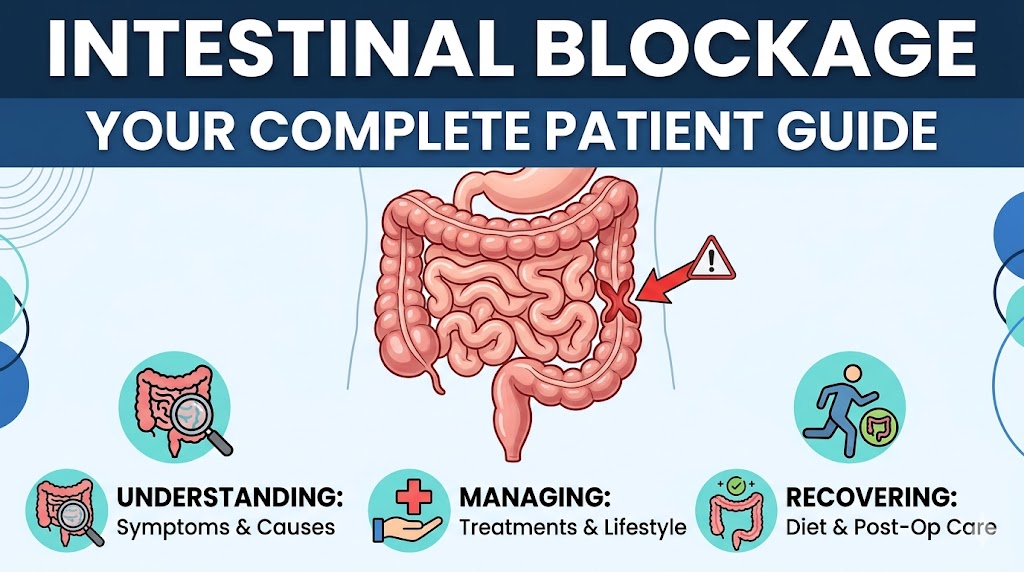
Intestinal Blockage: Your Complete Patient Guide to Understanding, Managing, and Recovering
Being told you have an intestinal blockage — or suspecting that you might — is a frightening experience. You may be in significant pain, unsure of what is happening inside your body, and anxious about what treatment will involve. This comprehensive patient guide is written to give you the full picture: what an intestinal blockage is, why it happens, what the experience of being diagnosed and treated is like, how to recover, and what you can do to protect yourself going forward.
This is the guide we wish every patient and their family had when facing this condition.
What Exactly Is an Intestinal Blockage?
An intestinal blockage — also called a bowel obstruction or intestinal obstruction — is a medical condition in which the normal flow of digestive material through the intestines is partially or completely stopped. This means that the food you eat, the fluids you drink, and the gas produced by digestion cannot move from where they are to where they need to go.
Your intestines are a remarkable system: approximately 6 to 8 meters of tubing that moves everything you eat through a carefully orchestrated series of muscular contractions called peristalsis. When a blockage occurs anywhere along this tube, the material piles up behind it. Gas and fluid accumulate. Pressure builds. The intestinal wall stretches. Blood supply can be compromised. Bacteria can leak. The situation can become dangerous rapidly.
Intestinal blockages can occur in the small intestine (approximately the first 6 meters, responsible for absorbing nutrients) or in the large intestine, also called the colon (the final 1.5 meters, responsible for absorbing water and forming stool). Both types are serious, though they have somewhat different causes, presentations, and management strategies.
The Two Types: Mechanical vs. Functional
Not all intestinal blockages are the same. Understanding the distinction helps you make sense of your diagnosis.
Mechanical Blockage
In a mechanical blockage, something physically prevents the intestinal contents from passing through. This physical obstacle can be:
Inside the intestinal tube: An impacted mass of stool (fecal impaction), a swallowed foreign body, a large gallstone (gallstone ileus), or a large benign polyp.
In the intestinal wall itself: A tumor growing inward and narrowing the tube, a stricture (scar tissue narrowing) from Crohn's disease or radiation treatment, or intussusception (where one segment of bowel slides into another like a telescope).
Outside the intestine: Adhesions (internal scar tissue from prior surgeries) wrapping around or kinking the bowel, a hernia trapping a loop of bowel, a volvulus (the bowel twisting on its own axis), or a tumor in an adjacent organ compressing the bowel from outside.
Functional Blockage (Ileus)
In a functional blockage, there is no physical obstacle. Instead, the muscles of the intestinal wall temporarily stop working — the gut becomes paralyzed. This is called ileus. The contents don't move because the propulsive mechanism has failed, not because the road is blocked.
Ileus most commonly occurs after abdominal surgery (post-operative ileus), during serious illness, with electrolyte imbalances (particularly low potassium), or as a side effect of opioid pain medications. It usually resolves once the underlying trigger is addressed.
Why Does an Intestinal Blockage Happen? The Main Causes
Small Intestine (Small Bowel) Blockages
Adhesions: By far the most common cause. When you have abdominal or pelvic surgery — whether appendectomy, hernia repair, bowel surgery, gynecological surgery, or anything else — the healing process creates fibrous scar tissue called adhesions. These internal bands of scar tissue can loop around or kink a segment of small bowel, causing obstruction. Adhesions can cause obstruction weeks, years, or even decades after the original surgery.
Hernias: When a portion of intestine pushes through a weakness in the abdominal wall (an inguinal or groin hernia, a femoral hernia, an umbilical hernia, or an incisional hernia at a prior surgical site), it can become trapped. A trapped (incarcerated) hernia that loses its blood supply becomes strangulated — a surgical emergency.
Crohn's disease: This chronic inflammatory condition of the intestine causes repeated episodes of inflammation and healing, which progressively scar and narrow the bowel wall. A Crohn's stricture can eventually narrow the intestinal lumen enough to cause obstruction.
Tumors: Primary tumors of the small bowel are rare, but metastatic cancer (cancer that has spread from elsewhere in the body, such as ovarian, colorectal, or gastric cancer) can involve the small bowel and cause obstruction.
Large Intestine (Colon) Blockages
Colorectal cancer: The single most common cause of large bowel obstruction in adults over 50. A tumor growing inside the colon progressively narrows the lumen until contents can no longer pass. In some patients, obstruction is the very first sign that a colon cancer is present.
Diverticular disease: Diverticula are small pouches that form in the colon wall, particularly in the sigmoid colon. Repeated episodes of diverticulitis (inflammation of these pouches) cause scarring and stricture formation that can eventually obstruct the colon.
Volvulus: The sigmoid colon (in adults) or the cecum (less commonly) can twist around its mesenteric axis, creating a closed loop that rapidly builds pressure and can lose its blood supply. Sigmoid volvulus is more common in elderly patients with chronic constipation or a redundant (extra-long) sigmoid colon.
Fecal impaction: In patients who are elderly, immobile, chronically dehydrated, or on opioid medications, stool can become so compacted in the rectum or colon that it cannot be passed, effectively blocking the colon.
The Patient Experience: What It Feels Like
Understanding the subjective experience of an intestinal blockage helps you recognize it and describe it accurately to medical providers.
The onset of pain is often the defining moment. Most patients describe it as unlike any digestive discomfort they have experienced before — waves of intense, cramping pain that may initially come and go, making you curl up or hold very still. Some describe it as feeling like the worst gas pain imaginable, except it does not resolve.
As time passes and the obstruction becomes more complete, the pain typically intensifies and the waves may become more frequent or less clearly separated. The abdomen begins to swell and feels increasingly tight and tender. Nausea builds and vomiting begins — first bringing up food, then bile (greenish fluid), and in severe cases, material that smells fecal.
The inability to pass gas is particularly telling and distressing. Many patients notice this and describe the sensation of pressure that builds but cannot be released.
As dehydration develops from vomiting and inability to take in fluids, patients feel progressively weaker, dizzy, and unwell.
In cases where complications develop — strangulation of the bowel, perforation — the pain transitions from colicky to constant and severe, fever develops, and the patient may deteriorate rapidly.
Getting to the Emergency Room: What Happens
If you arrive at an emergency room with intestinal blockage symptoms, here is what you can expect:
Triage and initial assessment: You will be assessed for the severity of your pain and vital signs. If you appear seriously unwell, you will be prioritized for immediate care.
History and examination: A doctor will ask detailed questions about your symptoms, surgical history, medical conditions, and medications. They will examine your abdomen — pressing gently to assess tenderness, listening with a stethoscope for bowel sounds, and assessing for distension.
Blood tests: These typically include a complete blood count (to look for signs of infection or anemia), electrolytes and kidney function (to assess dehydration), and a lactate level (elevated lactate suggests bowel ischemia — a serious finding).
Imaging: An abdominal X-ray is often the first imaging study ordered. It can show dilated loops of bowel — a telltale sign of obstruction. However, a CT scan of the abdomen and pelvis (with contrast, if kidney function allows) is the most informative test and is usually performed to confirm the diagnosis, identify the location and cause of the obstruction, and assess for complications.
Monitoring and IV access: You will be put on a monitor, have intravenous (IV) access established, and begin receiving IV fluids. You will be kept from eating or drinking by mouth.
What Treatment Involves
For partial obstructions without signs of complication, the initial approach is conservative:
A nasogastric (NG) tube may be passed through your nose into your stomach to suction out accumulated fluid and gas, relieving pressure and nausea.
IV fluids will replace what you have lost through vomiting and will correct electrolyte imbalances.
You will be monitored closely, with regular reassessment of your abdomen and blood tests. If you improve, the obstruction may resolve on its own (particularly with adhesive small bowel obstruction).
If you do not improve — or if you show signs of strangulation, perforation, or complete obstruction — surgery will be recommended.
Surgery for Intestinal Blockage
Surgery for intestinal blockage aims to relieve the obstruction and treat its cause. The specific procedure depends on what is found:
Adhesiolysis: Cutting the adhesive bands that are kinking or constricting the bowel. This can sometimes be done laparoscopically (minimally invasively through small holes with a camera), which means a faster recovery.
Hernia repair: Reducing the trapped bowel and repairing the hernia defect.
Bowel resection: If a segment of bowel is damaged, ischemic (starved of blood), or necrotic (dead), it must be removed. The cut ends are then either joined together (anastomosis) or, if conditions are unsafe for an anastomosis, a temporary stoma is created.
Colostomy or ileostomy: A stoma is an opening created in the abdominal wall where the bowel is brought to the surface, and stool drains into an external bag. This may be temporary (reversed in a later operation once healing is complete) or permanent, depending on the circumstances.
Detorsion of volvulus: The twisted bowel segment is untwisted, either endoscopically (with a colonoscope) or surgically. Elective surgery is usually recommended to prevent recurrence.
Recovery: What to Expect
In-hospital recovery: After surgery, you will remain in hospital while bowel function returns. This is usually indicated by passing gas — a milestone that nurses and doctors will ask about. Diet is reintroduced gradually, starting with clear fluids and progressing to solid food as the bowel wakes up. IV fluids continue until you can drink adequately. Most patients are discharged within 3-7 days for straightforward cases, though complex cases or complications can extend this significantly.
At-home recovery: Full recovery after surgery typically takes 4-8 weeks for open surgery (large incision) and 2-4 weeks for laparoscopic surgery (keyhole). You may feel tired, have incision discomfort, and need to modify your activity level. Your surgeon will advise on lifting restrictions, driving, and returning to work.
Diet after intestinal blockage: Initially, a low-fiber, easily digestible diet is recommended to allow the bowel to recover. Gradually, fiber is reintroduced. Staying well-hydrated is critical. Your healthcare team or a registered dietitian may provide specific dietary guidance based on the cause of your obstruction and the type of treatment you received.
Warning signs during recovery: Watch for and seek immediate medical attention for:
- Sudden return of severe abdominal pain or cramping
- Vomiting that prevents keeping fluids down
- Inability to pass gas or stool
- Fever above 38°C (100.4°F)
- Redness, swelling, or discharge from the surgical wound
- Signs of dehydration (dizziness, dark urine, extreme thirst)
Long-Term Considerations and Prevention
The likelihood of recurrence depends heavily on the underlying cause of your obstruction.
Adhesive obstruction: Adhesions can re-form after surgery and cause future obstructions. The recurrence rate for adhesive small bowel obstruction is estimated at 10-30% over a lifetime. There is no proven way to completely prevent adhesion formation, though newer surgical adhesion barriers (applied during surgery) may reduce risk.
Crohn's disease: Ongoing medical management of Crohn's disease is essential to reduce inflammation and slow stricture progression. Biologics and other advanced therapies have improved outcomes significantly.
Colorectal cancer: If obstruction was caused by colorectal cancer, ongoing oncological treatment (chemotherapy, further surgery) will be part of the care plan.
Hernia: If your obstruction was caused by a hernia, having the hernia repaired prevents recurrence.
General prevention strategies that benefit all patients:
Maintain adequate hydration: Dehydration thickens intestinal contents and promotes constipation. Aim for at least 1.5-2 liters of fluid per day unless medically restricted.
Eat a balanced diet with adequate fiber: Fiber promotes regular bowel movements and reduces constipation, particularly important for preventing large bowel obstruction from fecal impaction or worsening diverticular disease.
Stay active: Physical activity promotes healthy bowel motility. Even gentle walking is beneficial.
Manage constipation proactively: If you tend toward constipation — especially if you take opioid medications — work with your healthcare provider on a bowel regimen to keep things moving.
Screen for colorectal cancer: Regular colorectal cancer screening (colonoscopy, fecal immunochemical test) allows detection and removal of polyps before they become cancerous. Current recommendations suggest beginning screening at age 45 for average-risk individuals, earlier if there is a family history.
Disclose your surgical history: Always inform any healthcare provider treating you for abdominal symptoms about your previous surgeries, hernia history, or any prior obstructions.
The Emotional Side of Intestinal Blockage
An intestinal blockage is not just a physical experience — it is emotionally challenging as well. The sudden onset, the intensity of the pain, the fear of surgery, and the uncertainty about recovery can be deeply unsettling. Patients often describe feeling blindsided by how serious the condition turned out to be.
If you or a loved one is going through this experience, it is entirely normal to feel anxious, overwhelmed, or frightened. Ask your care team questions — there are no stupid questions when it comes to your health. If you are discharged home and feel uncertain about what to watch for, ask for written instructions.
For those with ongoing risk (such as people with Crohn's disease, a history of multiple obstructions, or advanced cancer), living with the knowledge that another episode may occur can be a significant psychological burden. Speaking with a counselor, a patient support group, or a specialist nurse can make a real difference.
Conclusion: Knowledge Is Your Best Tool
An intestinal blockage is a condition that rewards early recognition, prompt action, and informed decision-making. The more you understand about what is happening in your body, what the treatment involves, and what recovery looks like, the better placed you are to navigate this experience and come through it well.
If you are currently experiencing symptoms that concern you — abdominal pain, vomiting, inability to pass gas, or abdominal distension — do not wait. Seek medical care now. This is not a condition that improves with time when left untreated. With prompt and appropriate treatment, the great majority of patients with intestinal blockage recover fully and return to normal lives.