Rotator Cuff Injury: Causes, Symptoms, Diagnosis, and Treatment
What Is a Rotator Cuff Injury?
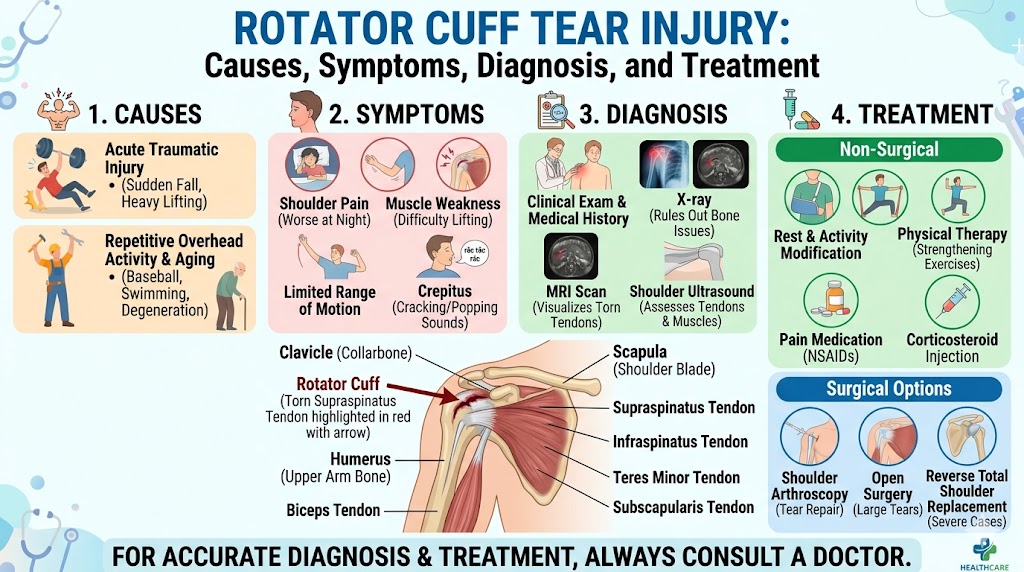
The rotator cuff is a group of four muscles and their associated tendons that surround the shoulder joint, keeping the head of the upper arm bone (humerus) firmly within the shallow socket of the shoulder (glenoid). These four muscles — the supraspinatus, infraspinatus, teres minor, and subscapularis — work together to provide stability and allow a wide range of shoulder movements. A rotator cuff injury refers to any damage to these muscles or tendons, ranging from mild inflammation and minor tears to complete ruptures that may require surgical intervention.
Rotator cuff injuries are among the most common causes of shoulder pain and disability, particularly in adults over the age of 40. According to the American Academy of Orthopaedic Surgeons, approximately 2 million people in the United States visit a doctor each year due to rotator cuff problems. The condition can affect athletes, manual laborers, and even sedentary individuals, making it a widespread musculoskeletal concern across all demographics.
Understanding the nature of a rotator cuff injury — how it occurs, what it feels like, and how it can be treated — is essential for proper management and recovery. Whether you are an overhead athlete dealing with chronic shoulder pain or someone who woke up with sudden shoulder weakness, this comprehensive guide will provide you with the knowledge you need to take the right steps toward healing.
Anatomy of the Rotator Cuff
To understand how rotator cuff injuries occur, it helps to first understand the anatomy of the shoulder. The shoulder joint is a ball-and-socket joint — the most mobile joint in the human body. This mobility, while allowing for a tremendous range of motion, also makes the shoulder inherently less stable than other joints like the hip.
The rotator cuff consists of four distinct muscles. The supraspinatus, located on top of the shoulder blade, is responsible for initiating arm abduction — the motion of lifting the arm away from the side of the body. It is the most commonly injured rotator cuff muscle, particularly at the point where it attaches to the greater tuberosity of the humerus. The infraspinatus, positioned on the back of the shoulder blade, is primarily responsible for external rotation of the arm and is the second most frequently torn rotator cuff muscle, often involved in injuries related to overhead sports such as swimming, tennis, and baseball. The teres minor is a small muscle that runs alongside the infraspinatus and assists in external rotation while helping stabilize the shoulder joint. The subscapularis, located on the front surface of the shoulder blade, is the largest of the four rotator cuff muscles, primarily responsible for internal rotation of the arm and playing a crucial role in shoulder stability, particularly in activities requiring forceful pushing or throwing motions.
Together, these muscles form a cuff of tissue around the humeral head, compressing the ball into the socket and providing dynamic stability throughout the full range of shoulder motion.
Types of Rotator Cuff Injuries
Rotator cuff injuries exist on a spectrum from mild to severe, and the type of injury will largely determine the appropriate course of treatment. Rotator cuff tendinitis, also known as tendinopathy or shoulder impingement syndrome, involves inflammation of one or more of the rotator cuff tendons. It is typically caused by repetitive overhead movements and does not involve a tear in the tendon fibers, but rather irritation and swelling that leads to pain and reduced function. A partial thickness tear means the tendon is damaged but not completely severed, with symptoms ranging from mild to severe depending on the extent of the damage. A full thickness (complete) tear means the tendon has been completely torn through, creating a hole or gap, and is often associated with significant weakness and functional limitations. These can occur acutely from sudden injury or develop gradually through progressive degeneration.
Acute rotator cuff tears occur suddenly, often as a result of a traumatic event such as a fall onto an outstretched arm or a sudden forceful pull, causing immediate sharp pain and rapid loss of strength. Degenerative tears, more common in older adults, develop over time due to gradual wear and breakdown of tendon tissue from poor blood supply, repetitive microtrauma, and age-related changes in tendon structure.
Common Causes of Rotator Cuff Injury
Rotator cuff injuries can result from a variety of factors, including acute trauma, repetitive stress, and age-related degeneration. As we age, the blood supply to the rotator cuff tendons diminishes, reducing the body's ability to repair everyday microscopic damage. The tendons become more brittle, less elastic, and more prone to tearing. This is why rotator cuff injuries are far more common in individuals over the age of 40, with incidence increasing significantly in those over 60.
Jobs or sports that require repeated overhead arm movements place excessive stress on the rotator cuff tendons. Carpenters, painters, electricians, swimmers, baseball pitchers, and tennis players are among those most at risk. Over time, the repetitive loading of the tendons without adequate recovery time can lead to tendinitis, partial tears, and eventually complete tears. A sudden traumatic event such as falling on an outstretched hand, lifting a heavy object improperly, or sustaining a direct impact to the shoulder can cause an immediate rotator cuff tear.
Shoulder impingement occurs when the rotator cuff tendons are compressed or "pinched" between the bones of the shoulder, particularly during overhead movements. Bony spurs that develop on the underside of the acromion can narrow the subacromial space and irritate the rotator cuff tendons over time, leading to inflammation and eventual tearing. Poor posture, rounded shoulders, and muscle imbalances can also alter the mechanics of the shoulder joint, increasing the load on the rotator cuff and contributing to injury over time.
Signs and Symptoms of Rotator Cuff Injury
The symptoms of a rotator cuff injury can vary considerably depending on the type, severity, and chronicity of the injury. Pain is the hallmark symptom and is typically felt in the front or side of the shoulder, often radiating down the outer arm toward the elbow. The pain is worsened by specific movements, particularly reaching overhead, lifting objects, or rotating the arm. Nighttime pain is very characteristic of rotator cuff injuries, with many patients reporting difficulty sleeping on the affected side.
Depending on which muscle is injured and the severity of the damage, individuals may experience noticeable weakness when lifting or rotating the arm. A rotator cuff injury often restricts the ability to move the shoulder through its normal range of motion — raising the arm above head level, reaching behind the back, or performing rotational movements may become painful or impossible without assistance. Some individuals also notice a clicking, popping, or grinding sensation during shoulder movements. In cases of large, chronic tears, the affected muscles may begin to atrophy from disuse, sometimes visible as a depression or hollow area around the shoulder.
Diagnosis of Rotator Cuff Injury
Accurate diagnosis is essential to guide appropriate treatment decisions. The diagnostic process begins with a thorough medical history and physical examination, including specific provocative tests such as the Empty Can Test for the supraspinatus, the Drop Arm Test for complete tears, the Hornblower's Sign for the teres minor, and the Lift-Off Test for the subscapularis. While X-rays cannot directly visualize tendons, they are useful for ruling out bony abnormalities and identifying bone spurs that may contribute to impingement.
Diagnostic ultrasound can effectively visualize the rotator cuff tendons and identify tears, tendinitis, and bursitis in real time, though its accuracy is highly operator-dependent. Magnetic resonance imaging (MRI) is considered the gold standard imaging modality for evaluating rotator cuff injuries, providing detailed visualization that allows for precise characterization of the size, location, and extent of tears. MRI is particularly valuable in surgical planning. In some cases, an MRI arthrogram with contrast dye injected into the joint may be used to enhance detection of partial tears, and diagnostic arthroscopy may be performed when imaging results are inconclusive or when surgical intervention is already being considered.
Treatment Options for Rotator Cuff Injury
The treatment of a rotator cuff injury depends on the type and severity of the injury, the patient's age, activity level, functional goals, and overall health. Treatment approaches range from conservative non-surgical management to surgical repair and reconstruction.
Conservative (Non-Surgical) Treatment
The first line of treatment for most rotator cuff injuries involves reducing or eliminating activities that aggravate symptoms. Applying ice to the shoulder for 15-20 minutes several times a day can help reduce inflammation and alleviate pain, particularly in the acute phase of injury. Nonsteroidal anti-inflammatory drugs (NSAIDs) such as ibuprofen or naproxen can be effective in reducing pain and inflammation. Physical therapy is a cornerstone of rotator cuff injury rehabilitation, whether the patient undergoes surgery or not. A skilled physical therapist will design a comprehensive program that addresses flexibility, strength, and neuromuscular control, including stretching exercises to restore range of motion, strengthening exercises targeting the rotator cuff and scapular stabilizers, postural correction, and activity-specific training.
When pain is severe and limiting participation in physical therapy, a corticosteroid injection into the subacromial space can provide significant, though often temporary, pain relief. Platelet-rich plasma (PRP) therapy is an emerging biologic treatment that involves concentrating growth factors from the patient's own blood and injecting them into the injured tissue to stimulate healing. While evidence for PRP in rotator cuff injuries is still evolving, some studies suggest potential benefits for partial tears and tendinopathy.
Surgical Treatment
Surgery may be recommended when conservative treatment fails to relieve symptoms after several months, when there is a large or complete tear, or when the patient is a high-demand athlete or worker who requires full shoulder function. Arthroscopic rotator cuff repair is the most common surgical procedure, using small incisions and a tiny camera to guide the surgeon in reattaching the torn tendon to the bone with small anchors. This minimally invasive approach offers the advantages of smaller incisions, less postoperative pain, reduced risk of infection, and faster recovery compared to open surgery.
In cases of very large or complex tears, an open surgical approach may be necessary. For irreparable rotator cuff tears where the tendon is too damaged to be reattached, tendon transfer surgery may be considered, rerouting a healthy tendon from another part of the body to compensate for the function of the irreparable tendon. For elderly patients with massive irreparable tears combined with significant shoulder arthritis, reverse total shoulder replacement may be the most appropriate surgical option, using a specially designed implant that allows the deltoid muscle to compensate for the absent rotator cuff.
Recovery and Rehabilitation
Recovery from a rotator cuff injury depends heavily on the severity of the injury and whether surgical intervention was required. Non-surgical rehabilitation typically requires several weeks to a few months, while recovery from surgical repair can take anywhere from six months to a full year for complete healing and return to full activity. Following surgery, the shoulder is typically immobilized in a sling for four to six weeks to protect the repaired tendon during the initial healing phase.
Physical therapy begins shortly after surgery, starting with passive range of motion exercises and gradually progressing to active motion, strengthening, and functional activities as healing progresses. Key milestones generally include reduction of pain and swelling in the first few weeks, restoration of full passive range of motion by 8-12 weeks, return of functional strength by 4-6 months, and return to sport or heavy labor by 9-12 months. Patient compliance with the rehabilitation program is one of the most important predictors of successful outcomes.
Prevention of Rotator Cuff Injury
While not all rotator cuff injuries can be prevented, several strategies can significantly reduce the risk of developing this condition. Maintaining strong and balanced shoulder musculature through regular strengthening exercises is one of the best ways to protect the rotator cuff. Internal and external rotation exercises with resistance bands or light dumbbells are excellent preventive measures that help maintain joint stability and distribute forces evenly across the shoulder joint.
Using proper biomechanical technique during all activities is essential — whether you are an athlete, a worker performing overhead tasks, or someone engaged in recreational activities. Avoiding sudden increases in training volume or intensity helps prevent cumulative microtrauma. Maintaining good posture throughout the day, ensuring ergonomically set up workstations, and taking regular breaks from repetitive tasks can reduce chronic stress placed on the rotator cuff. Proper warm-up before physical activity and a thorough cool-down with stretching after activity both help maintain flexibility and reduce injury risk. One of the most important aspects of prevention is paying attention to early warning signs — shoulder pain or discomfort that persists for more than a few days following activity should not be ignored, as early evaluation and treatment of minor shoulder problems can prevent them from progressing to more serious injuries.
When to See a Doctor
You should seek medical care if you experience sudden, severe shoulder pain following a traumatic event such as a fall or collision, significant weakness that prevents you from lifting the arm, shoulder pain that persists for more than a few weeks despite rest and over-the-counter treatment, progressive worsening of symptoms despite conservative measures, or any loss of sensation in the arm or hand. Early diagnosis and appropriate management are key to optimal outcomes. Delaying treatment — particularly in cases of complete tears — can allow the tendon to retract further and the surrounding muscles to atrophy, making subsequent surgical repair more difficult and potentially compromising the ultimate result.
Living with a Rotator Cuff Injury
For many individuals, particularly older adults with degenerative tears, learning to manage a rotator cuff injury as a chronic condition may be necessary. This does not mean a diminished quality of life — with appropriate treatment, many people with rotator cuff injuries can maintain excellent shoulder function and continue to engage in most activities they enjoy. Pain management through a combination of medications, therapeutic modalities, and activity modification can allow for comfortable participation in daily activities. Regular physical therapy and home exercise programs help maintain strength and flexibility.
Psychological factors also play an important role in recovery. Fear of re-injury, frustration with a slow recovery, and the impact of pain on sleep and daily activities can all contribute to reduced motivation and poorer outcomes. Working with a healthcare team that addresses both the physical and psychological aspects of recovery — and setting realistic expectations for the healing process — can greatly improve overall quality of life and functional outcomes.
Conclusion
A rotator cuff injury is a common yet potentially debilitating condition that affects millions of people worldwide. Whether caused by acute trauma, repetitive overhead stress, or the natural aging process, damage to the muscles and tendons of the rotator cuff can significantly impact shoulder function and quality of life. Fortunately, a wide range of effective treatment options — from physical therapy and anti-inflammatory medications to arthroscopic surgical repair — are available to help individuals recover and return to full activity.
Understanding the anatomy of the shoulder, recognizing the signs and symptoms of rotator cuff damage, and seeking timely medical evaluation are all critical steps in managing this condition effectively. With the right diagnosis, appropriate treatment, and dedicated rehabilitation, the vast majority of individuals with rotator cuff injuries can expect meaningful improvement in pain, strength, and function. Prevention through regular exercise, proper technique, and body awareness remains the best long-term strategy for maintaining healthy, pain-free shoulders throughout life. If you suspect you may have a rotator cuff injury, consult with an orthopedic specialist or sports medicine physician who can provide a thorough evaluation and develop a personalized treatment plan tailored to your specific needs and goals.