Rotator Cuff Symptoms: How to Recognize, Understand, and Act on Shoulder Warning Signs
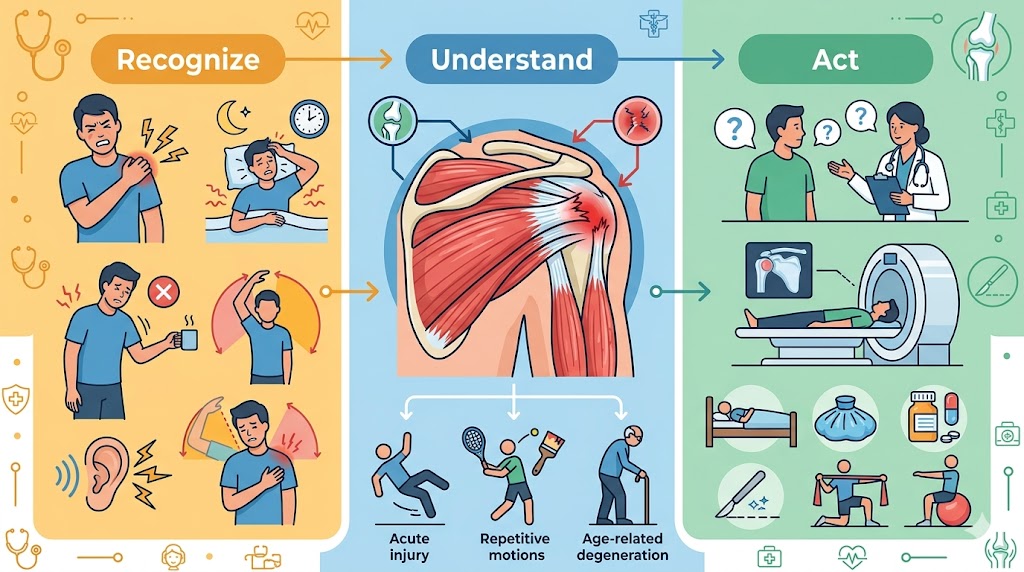
Why Rotator Cuff Symptoms Matter
The shoulder is the most mobile joint in the human body — and one of the most frequently injured. At the center of that vulnerability sits the rotator cuff, a group of four muscles and tendons that wrap around the head of the upper arm bone, providing the stability and control that make the shoulder's extraordinary range of motion possible. When the rotator cuff is damaged, the symptoms it produces can range from a barely perceptible ache to a profound functional impairment that disrupts sleep, work, sport, and the simple activities of daily life.
Rotator cuff symptoms are among the most commonly encountered musculoskeletal complaints in clinical practice, affecting people across all age groups — from young athletes whose careers depend on a healthy throwing arm, to older adults for whom lifting a grocery bag or combing their hair has become a painful ordeal. Yet despite how common these symptoms are, they are frequently misinterpreted, minimized, or attributed to other causes, leading to delays in appropriate treatment that can significantly worsen outcomes.
This guide offers a thorough, nuanced exploration of rotator cuff symptoms — what they are, what causes them, how they differ depending on the type and severity of the underlying injury, and what each symptom pattern tells us about the state of the shoulder. Whether you are experiencing shoulder discomfort for the first time or have been managing a longstanding shoulder problem without clear answers, understanding your symptoms in depth is the essential first step toward effective care and recovery.
The Anatomy Behind the Symptoms
Before diving into the specific symptoms of rotator cuff pathology, it is helpful to understand why this particular group of structures produces the symptoms it does. The four muscles of the rotator cuff — the supraspinatus, infraspinatus, teres minor, and subscapularis — each originate on the scapula (shoulder blade) and attach via tendons to the head of the humerus. Together, they create a muscular cuff around the glenohumeral joint that serves two primary purposes: generating the forces needed for shoulder movement, and compressing the humeral head into the shallow glenoid socket to maintain joint stability throughout all positions and motions.
The supraspinatus tendon, which runs through the narrow subacromial space between the humeral head and the acromion, is by far the most frequently injured component of the rotator cuff. Its anatomical position makes it vulnerable to both mechanical compression (impingement) and tensile overload during overhead activities and lifting. The infraspinatus and teres minor, located on the posterior (back) surface of the shoulder blade, are the primary external rotators and are particularly stressed during overhead throwing and the deceleration phase of sporting movements. The subscapularis, on the front of the shoulder blade, is the primary internal rotator and anterior stabilizer, and its injury produces a distinctive set of symptoms related to front-of-shoulder pain and instability.
When any of these tendons becomes inflamed, partially torn, or completely ruptured, the resulting symptoms are a direct consequence of the structural and biomechanical disruption that occurs. Pain arises from the activation of nociceptors (pain-sensing nerve endings) within the tendon tissue and surrounding bursa. Weakness results from the mechanical failure of the tendon to transmit muscle force to the bone effectively. Stiffness develops as a protective response of the surrounding soft tissues and joint capsule to the ongoing injury and inflammation. Understanding these mechanisms helps make sense of the specific symptom patterns described below.
Core Rotator Cuff Symptoms
Shoulder Pain: The Central Symptom
Pain is the symptom that drives the vast majority of people with rotator cuff problems to seek medical attention, and for good reason — it is nearly universal across all types and severities of rotator cuff pathology. However, the character, location, and behavior of rotator cuff pain are not uniform, and recognizing its specific features is key to distinguishing it from other causes of shoulder discomfort.
Classic rotator cuff pain is felt primarily on the outer (lateral) aspect of the shoulder, often described as a deep, diffuse aching that is difficult to localize to a single precise point. Many patients gesture toward the deltoid region — the rounded outer aspect of the upper arm — when asked to point to where it hurts, rather than pointing to the joint itself. This is because the rotator cuff tendons refer pain to this area through a mechanism called referred pain, in which the actual source of the pain signal (the tendon) is perceived in a different location (the deltoid region and outer arm) due to the way the nervous system processes and maps pain from deep structures.
From the lateral shoulder, rotator cuff pain frequently radiates down the outer arm toward the elbow. In some cases it may extend as far as the forearm or wrist, though this more distal radiation is less typical of purely rotator cuff-related pain and may suggest concurrent biceps tendon involvement or cervical nerve root compression. Pain at the front of the shoulder — particularly well-localized tenderness in the groove on the front of the humerus where the biceps tendon runs — suggests involvement of the long head of the biceps tendon, which frequently accompanies rotator cuff pathology. Posterior shoulder pain, felt at the back of the joint or into the back of the deltoid, is more characteristic of infraspinatus or teres minor pathology, or of secondary posterior capsule tightness that commonly develops in association with chronic rotator cuff problems.
The intensity of rotator cuff pain does not reliably reflect the severity of the underlying damage. This is one of the most clinically important — and counterintuitive — features of rotator cuff symptoms. Some individuals with small, partial tears experience severe, function-limiting pain, while others with large or even complete tears report only mild discomfort or no pain at all. The mismatch between structural damage and symptom severity is explained by several factors, including individual variation in pain sensitivity, the degree of associated bursitis and inflammation, the chronicity of the tear (with very longstanding tears often producing less pain as the nervous system adapts), and the extent to which surrounding structures have compensated for the rotator cuff's altered function.
Pain with Specific Movements: The Painful Arc
One of the most diagnostically useful features of rotator cuff symptoms is the pattern of pain provocation with specific movements. Unlike generalized shoulder joint pain, which tends to be provoked by any movement of the shoulder, rotator cuff pain is typically most intense during specific ranges of motion and with specific types of loading.
The "painful arc" — a zone of increased pain occurring between approximately 60 and 120 degrees of arm elevation — is a hallmark clinical finding in rotator cuff impingement and tendinitis. Within this arc, the supraspinatus tendon is maximally compressed between the humeral head and the undersurface of the acromion, producing the characteristic sharp increase in pain that patients report when raising their arm. Below 60 degrees and above 120 degrees (if the patient can reach there), the pain often diminishes significantly, creating a characteristic wave pattern of pain during arm elevation that is highly specific for subacromial pathology.
Overhead activities are universally provocative for rotator cuff symptoms — reaching for objects on high shelves, washing hair, hanging laundry, painting ceilings, serving in tennis, or throwing a ball all consistently worsen rotator cuff pain because they require sustained or repeated subacromial compression and rotator cuff tendon loading in the painful arc range. Many patients learn to adapt their movement patterns to minimize overhead use, substituting compensatory strategies (such as using the opposite arm, bending the trunk rather than raising the arm, or using step stools) that can become habitual over time and lead to secondary problems in the opposite shoulder or the spine.
Internal rotation behind the back — the movement of reaching up the back as when fastening a bra, tucking in a shirt, or reaching into a back pocket — is another highly characteristic provocative movement for rotator cuff symptoms. This movement places the supraspinatus tendon under tensile stress and compresses it against the posterior acromion, making it acutely sensitive in the presence of tendinitis or tearing. Patients often describe the movement as producing a sharp, catching pain at the shoulder that makes the action feel "blocked" even when the joint itself has not become structurally restricted.
External rotation against resistance — such as trying to open a heavy door with the elbow bent, or being tested by a clinician who applies resistance to the forearm while asking the patient to rotate outward — is the most sensitive provocative maneuver for infraspinatus and teres minor pathology. Many patients with posterior rotator cuff tears notice difficulty and pain specifically with activities that require external rotation strength, such as throwing, serving, or reaching behind the head.
Nighttime Pain and Sleep Disruption
Among all rotator cuff symptoms, nighttime pain stands out as perhaps the most diagnostically distinctive and functionally disruptive. The association between rotator cuff pathology and sleep disturbance is so reliable that many orthopedic surgeons consider it a near-pathognomonic feature — a symptom so characteristic that its presence alone significantly raises the probability of rotator cuff pathology.
The mechanisms underlying nighttime rotator cuff pain are multifactorial. When lying on the affected shoulder, direct compression of the inflamed subacromial bursa and rotator cuff tendons dramatically increases local tissue pressure, activating nociceptors and producing intense pain that may immediately wake the patient or prevent initial sleep onset. When lying on the opposite side, the affected arm often falls forward and inward — into a position of horizontal adduction and internal rotation — that tensions the posterior capsule and places the supraspinatus tendon in a maximally stressed position. Even supine (back-lying) positions can be problematic, as the arm resting at the side tends to fall into slight internal rotation, and patients who instinctively try to externally rotate the arm to find a more comfortable position may repeatedly wake during position changes.
The circadian variation in endogenous cortisol — the body's natural anti-inflammatory hormone — also contributes to the nocturnal intensification of rotator cuff pain. Cortisol levels follow a diurnal rhythm with a peak in the early morning hours and a trough in the middle of the night, meaning that anti-inflammatory protection is at its lowest precisely when patients are lying still and attempting to sleep. This physiological timing amplifies the inflammatory pain that is already heightened by the mechanical factors described above.
The functional consequences of sleep disruption secondary to rotator cuff pain extend well beyond simple fatigue. Chronic sleep deprivation lowers the central pain threshold, making all pain experiences — not just shoulder pain — more intense and less tolerable. It impairs cognitive function, mood, immune activity, and emotional regulation, creating a vicious cycle in which poor sleep worsens pain, which further disrupts sleep, which further worsens pain. This cycle is a major contributor to the development of chronic pain syndromes in individuals with unresolved rotator cuff pathology, and addressing sleep quality is therefore an important component of comprehensive rotator cuff symptom management.
Shoulder Weakness
Weakness in shoulder movements is a cardinal symptom of rotator cuff injury and carries significant diagnostic and prognostic weight. Its presence, severity, and specific pattern all provide important information about which tendons are involved and how badly they are damaged.
Weakness in arm abduction — difficulty raising the arm out to the side against gravity or resistance — is the most clinically prominent weakness pattern in rotator cuff injury and is most commonly associated with supraspinatus tendon damage. Patients may find that they can raise the arm to shoulder height with difficulty but are unable to maintain it against even light resistance, a finding that produces the classic "drop arm sign" when the examiner releases the arm at shoulder height in patients with complete tears. In severe cases, the patient cannot initiate abduction at all without first "hiking" the shoulder upward using the trapezius muscle to compensate.
Weakness in external rotation — difficulty turning the arm outward when the elbow is bent — points to infraspinatus or teres minor involvement. This weakness pattern may be subtle and may only become apparent during resisted testing or during performance of demanding activities such as throwing or serving. A patient who reports that their throwing velocity or accuracy has declined, or who describes the arm feeling "dead" or "heavy" during the late cocking and early acceleration phases of throwing, is often describing the functional consequence of posterior rotator cuff weakness.
Weakness in internal rotation, while less commonly the primary complaint, is associated with subscapularis tendon injury and may manifest as difficulty with activities that require forceful pushing, pressing, or reaching behind the back. The Belly Press Test — in which the patient presses the hand against the abdomen with the elbow forward — and the Bear Hug Test — in which the patient resists the examiner's attempt to lift the hand off the opposite shoulder — are specific clinical tests designed to detect subscapularis weakness.
It is essential to distinguish between weakness due to true structural failure of the tendon and weakness caused by pain inhibition — the voluntary or involuntary avoidance of a movement because it hurts, rather than because the muscle is actually incapable of generating force. Pain inhibition is common in rotator cuff pathology and can mimic structural weakness convincingly. Clinicians typically use a combination of manual muscle testing, specific clinical tests, and imaging to differentiate between these two mechanisms, as the distinction has important implications for treatment planning.
Stiffness and Restricted Range of Motion
Loss of shoulder range of motion is a common companion symptom of rotator cuff pathology, though its cause and character differ depending on the phase and severity of the condition. In most cases of rotator cuff tendinitis and incomplete tears, the restriction in range of motion is pain-related — the joint itself retains its full structural mobility, but pain prevents the patient from achieving or sustaining certain positions. This type of restriction is characterized by preserved or near-normal passive range of motion (when the examiner moves the arm for the patient) in the absence of significant joint capsule pathology.
However, when rotator cuff pathology is longstanding, secondary stiffness of the shoulder joint capsule can develop through a process of fibrosis driven by the combination of disuse, protective muscle guarding, and the spread of inflammatory mediators to the capsular tissue. In its most severe form, this secondary stiffness can evolve into a true adhesive capsulitis (frozen shoulder) — a condition characterized by marked global restriction of both active and passive shoulder range of motion in all planes, accompanied by severe pain. The relationship between rotator cuff tears and frozen shoulder is well-established, with studies suggesting that a significant proportion of frozen shoulder cases are preceded by or concurrent with rotator cuff pathology.
Early identification of developing range of motion restriction — and prompt initiation of appropriate stretching and mobilization — is one of the most important aspects of preventing the progression from a manageable rotator cuff problem to a complicated, multi-layered condition involving both tendon pathology and capsular fibrosis. Patients who are told simply to "rest" their shoulder without any guidance on maintaining mobility often develop worsening stiffness that significantly prolongs and complicates their recovery.
Clicking, Popping, and Crepitus
Many patients with rotator cuff symptoms report hearing or feeling unusual sounds or sensations within the shoulder during movement. These auditory and tactile phenomena — described variously as clicking, snapping, popping, grinding, or crackling — are collectively referred to as crepitus when they involve a grinding or grating quality, and as clunking or catching when they involve a more discrete mechanical sensation.
In the context of rotator cuff pathology, crepitus and clicking can result from several mechanisms. Inflamed, thickened, or roughened tendon surfaces may catch as they glide beneath the acromion or through the subacromial space during arm elevation. A partially torn tendon with a frayed edge may intermittently snag on surrounding structures, producing a painful click or catch at a consistent point in the range of motion. Subacromial bursitis, with its inflamed and thickened bursal walls, may produce grinding during movement as the bursal surfaces rub against each other or against the adjacent tendon. In cases of complete tendon rupture, the free end of the torn tendon can occasionally catch within the joint, producing an audible or palpable clunk.
The clinical significance of shoulder sounds in the context of rotator cuff symptoms depends heavily on whether they are associated with pain and whether they have changed over time. Painless, intermittent clicking in an otherwise asymptomatic shoulder is common and usually benign, requiring no specific investigation or treatment. Painful clicking or grinding — particularly when it is consistently reproduced at the same point in the range of motion, when it has developed or worsened in association with other rotator cuff symptoms, or when it is accompanied by a sense of catching or giving way — warrants professional evaluation to determine whether it reflects significant structural pathology.
Localized Tenderness
The ability to reproduce shoulder pain by pressing on specific anatomical landmarks — a finding called point tenderness — is one of the most practically useful physical examination findings in rotator cuff assessment. The location of maximum tenderness can help the examining clinician identify which specific structures are most likely involved, guiding both the clinical diagnosis and the choice of targeted treatments.
Tenderness over the greater tuberosity — the bony prominence on the outer surface of the upper humerus where the supraspinatus and infraspinatus tendons attach — is the most common location of point tenderness in rotator cuff pathology. The supraspinatus attachment is accessible just anterior (in front of) the top of the acromion, and digital pressure in this area reliably reproduces the patient's pain in supraspinatus tendinitis or tearing. Infraspinatus tenderness is found slightly more posteriorly and inferiorly on the greater tuberosity. Subscapularis pathology produces tenderness over the lesser tuberosity, on the front of the humerus just medial to the bicipital groove.
The subacromial region — the soft tissue area just beneath the leading edge of the acromion — is typically tender in subacromial bursitis and impingement syndrome, and subacromial tenderness that is significantly reduced after an injection of local anesthetic into this space (a positive "impingement test" or "Neer's test") strongly supports a subacromial source of the patient's symptoms. Tenderness specifically along the bicipital groove — the vertical groove on the front of the humerus where the long head of the biceps tendon runs — suggests biceps tendinitis, which commonly coexists with rotator cuff pathology and may significantly contribute to anterior shoulder pain.
Symptom Patterns by Injury Type
Tendinitis and Early Impingement
In the earliest stages of rotator cuff pathology — tendinitis without structural tearing — symptoms are typically activity-related and intermittent. Pain develops during or after provocative overhead activities and resolves with rest. Stiffness may be present in the morning but warms up quickly with movement. Weakness, if present, is usually mild and effort-dependent rather than true structural weakness. Sleep disturbance may begin to occur at this stage, particularly after days of heavy shoulder use, but is not yet a nightly occurrence. Many individuals in this stage dismiss their symptoms as "soreness" or attribute them to normal aging or overexertion, and delay seeking evaluation until the condition has advanced.
Partial Thickness Rotator Cuff Tears
As the continuum of rotator cuff pathology advances from tendinitis to partial tearing, symptoms typically become more persistent, more severe with provocative activities, and more intrusive at rest and during sleep. Pain that previously resolved completely with rest may now be present as a background ache even during quiet activities. Sleep disturbance becomes more consistent and more disruptive. Measurable weakness may begin to appear on clinical testing, even if the patient has not yet noticed significant functional limitations in daily activities. The painful arc becomes more pronounced, and specific provocative tests (Empty Can, Hawkins-Kennedy, Neer's sign) more reliably positive. Patients in this phase often report that their symptoms fluctuate significantly from day to day, with clear flare-ups following overuse and relative improvement with rest — a pattern that can create a misleading impression that the problem is "getting better" during quiet periods.
Full-Thickness (Complete) Rotator Cuff Tears
Complete rupture of one or more rotator cuff tendons produces the most dramatic symptom profile in the rotator cuff pathology spectrum, though — paradoxically — not always the most pain. In acute traumatic complete tears, the symptom onset is sudden and dramatic: a sharp, burning pain at the moment of the injury, often accompanied by a felt or heard "pop," followed by immediate, profound weakness and inability to raise the arm against gravity. This presentation, which is more common in younger, previously healthy individuals who experience a sudden forceful overload, represents a surgical urgency and should be evaluated without delay.
In contrast, degenerative complete tears — which develop gradually over months or years in older individuals — may present with a more gradual evolution of symptoms, and some patients are genuinely surprised to learn that they have a complete tear because their pain, while chronic, has never been dramatically severe. The most consistent clinical feature of a large complete rotator cuff tear is weakness that persists despite appropriate pain management, and particularly the combination of profound abduction weakness with relatively preserved passive range of motion. The presence of visible muscle atrophy — hollowing of the shoulder contour above and below the spine of the scapula — indicates a chronic, large, or massive tear with secondary muscle wasting and is an important prognostic indicator.
Calcific Tendinitis
Calcific tendinitis — the deposition of calcium hydroxyapatite crystals within the rotator cuff tendons, most commonly the supraspinatus — produces a symptom pattern that deserves specific mention because of its distinctive and sometimes alarming presentation. During the formative phase, when calcium deposits are being laid down, symptoms may be mild and indistinguishable from ordinary tendinitis. However, during the resorptive phase — when the body begins to break down and reabsorb the calcium — the released calcium crystals produce an intense acute inflammatory reaction that can cause severe, rapidly escalating shoulder pain over the course of hours to days. This acute presentation may mimic septic arthritis or a severe acute rotator cuff tear and frequently prompts emergency room visits. The pain during a calcific tendinitis flare is often described as the worst shoulder pain the patient has ever experienced, and simple analgesics may be entirely insufficient for relief.
Early Warning Signs Not to Ignore
Because rotator cuff symptoms are so often minimized or misattributed, it is worth highlighting several early warning signs that should prompt timely evaluation rather than watchful waiting. Shoulder pain that interferes with sleep — even once or twice per week — is an early warning sign of rotator cuff pathology that is frequently underappreciated by patients who manage to function reasonably well during the day. Difficulty or pain when reaching behind the back or reaching to the opposite shoulder across the body — movements that internally rotate and adduct the arm — is another early indicator, as these movements are consistently provocative for supraspinatus and infraspinatus pathology even at early stages.
A sense of shoulder fatigue or heaviness during or after activities that previously caused no discomfort, particularly overhead sporting or occupational activities, may indicate the onset of rotator cuff weakness that has not yet produced objective findings on physical examination. Any sudden change in a previously stable shoulder pain pattern — a sudden increase in severity, a new component of weakness, or a new episode of catching or giving way — warrants prompt evaluation, as it may signal an acute tear superimposed on pre-existing chronic tendinopathy.
In older adults, the gradual development of shoulder weakness without a clear traumatic precipitant — particularly when accompanied by the characteristic pattern of difficulty raising the arm, loss of external rotation strength, and nighttime pain — should be evaluated for the possibility of a degenerative complete rotator cuff tear, even when the pain level seems insufficient to justify imaging. Timely diagnosis of these chronic tears, while it does not always lead to immediate surgical intervention, provides essential information for planning appropriate conservative management and for making informed decisions about the timing and appropriateness of eventual surgical repair.
How Symptoms Guide Diagnosis
Rotator cuff symptoms are not just important for identifying that a problem exists — their specific pattern, combination, and evolution provide crucial information that guides the entire diagnostic and treatment process. Clinicians use a structured approach to symptom analysis that begins with a detailed history — the onset and duration of symptoms, their character and location, the activities and positions that provoke and relieve them, the presence and pattern of any weakness or stiffness, any history of prior shoulder injuries or treatments, and the impact of symptoms on function and quality of life.
This symptom history is then correlated with the findings of a targeted physical examination, during which specific clinical tests are applied to reproduce the patient's symptoms and assess the integrity of individual rotator cuff tendons. The Empty Can Test (supraspinatus), the External Rotation Lag Sign (infraspinatus), the Hornblower's Sign (teres minor), the Belly Press and Lift-Off Tests (subscapularis), and a series of impingement provocation tests (Neer, Hawkins-Kennedy) together provide a detailed functional map of the rotator cuff that guides both the clinical diagnosis and the selection of imaging studies.
When imaging is indicated — most commonly MRI or ultrasound — the findings are always interpreted in the context of the patient's symptoms rather than in isolation. The principle that symptoms, not images, should drive treatment decisions is fundamental in rotator cuff management: a small tear found on imaging in a patient with severe symptoms may warrant more aggressive treatment than a large tear found incidentally in a patient with minimal complaints. This symptom-centered approach to diagnosis and treatment reflects a mature understanding of the complex relationship between structural findings and clinical presentation in rotator cuff disease.
When Symptoms Require Immediate Attention
While most rotator cuff symptoms warrant evaluation on a scheduled basis rather than an emergency basis, certain symptom presentations require same-day or emergency assessment. A sudden, severe onset of shoulder pain following a traumatic event — particularly when accompanied by immediate profound weakness, inability to raise the arm, or a felt or heard pop at the moment of injury — may indicate a complete acute rotator cuff tear or concurrent shoulder dislocation that requires urgent evaluation and may be a surgical emergency in younger, active patients.
Progressive neurological symptoms — numbness, tingling, or weakness radiating from the shoulder down the arm and into the hand — associated with a shoulder injury require urgent assessment to exclude brachial plexus injury or cervical spine injury that may need different and more urgent intervention. Shoulder pain accompanied by fever, redness, warmth, swelling, and systemic illness requires emergency evaluation to exclude septic arthritis — a joint infection that can rapidly destroy cartilage and bone and requires urgent joint drainage and antibiotic therapy.
Managing Rotator Cuff Symptoms: An Overview
The management of rotator cuff symptoms spans a continuum from simple self-care measures through structured rehabilitation and, where necessary, surgical intervention. The fundamental principles that guide symptom management — regardless of the specific approach chosen — include accurately identifying the underlying pathology and its contribution to symptoms, addressing both the pain and the functional deficits that symptoms produce, correcting the biomechanical and lifestyle factors that perpetuate symptoms, and restoring the shoulder's strength and stability to reduce the risk of recurrence.
For mild to moderate symptoms associated with tendinitis and small partial tears, a structured physical therapy program targeting rotator cuff and scapular strengthening, combined with activity modification, anti-inflammatory measures, and attention to posture and ergonomics, is the cornerstone of management and produces excellent outcomes in the majority of cases. More severe symptoms, complete tears, or symptoms that fail to respond to conservative management may require interventional procedures — including corticosteroid injections, platelet-rich plasma therapy, or surgical repair — to achieve adequate symptom relief and functional restoration.
Regardless of the treatment approach chosen, patient education and self-advocacy are essential. Understanding your symptoms — what they mean, what makes them better or worse, and what to watch for in terms of progression — empowers you to engage actively in your own care, to communicate effectively with your healthcare team, and to make informed decisions about treatment options. This guide is intended to be a starting point for that understanding; your healthcare provider remains the essential partner for translating that understanding into a personalized plan for your specific situation.
Conclusion
Rotator cuff symptoms — shoulder pain, nighttime pain, weakness, stiffness, clicking, and tenderness — form a rich and informative clinical picture that, when properly recognized and interpreted, points clearly toward the diagnosis and guides the path to effective treatment. Their variability, their ability to mimic other conditions, and the frequent disconnect between symptom severity and structural damage make them both challenging and fascinating to understand.
The most important message of this guide is that rotator cuff symptoms should not be ignored, minimized, or attributed to inevitable aging without proper evaluation. Early recognition, accurate diagnosis, and prompt initiation of appropriate treatment consistently produce better outcomes than delayed intervention after symptoms have become chronic, structural damage has progressed, and secondary complications such as muscle atrophy and capsular fibrosis have developed. Your shoulder symptoms are telling you something important — listening to them carefully, and acting on what they reveal, is the smartest thing you can do for your long-term shoulder health.