Shoulder Rotator Cuff: Anatomy, Function, and Common Injuries
What Is the Shoulder Rotator Cuff?
The shoulder rotator cuff is one of the most important and complex structures in the human body. It is a group of four muscles and their associated tendons that surround the head of the upper arm bone (humerus) and attach it to the shoulder blade (scapula). Together, these muscles and tendons act like a cuff — holding the ball of the humerus securely within the shallow socket of the scapula (the glenoid), while simultaneously enabling the enormous range of motion that makes the shoulder the most mobile joint in the body.
Understanding the shoulder rotator cuff — its anatomy, how it works, and how it can be injured — is essential knowledge for anyone experiencing shoulder pain, shoulder weakness, or limited arm movement.
The Four Muscles of the Shoulder Rotator Cuff
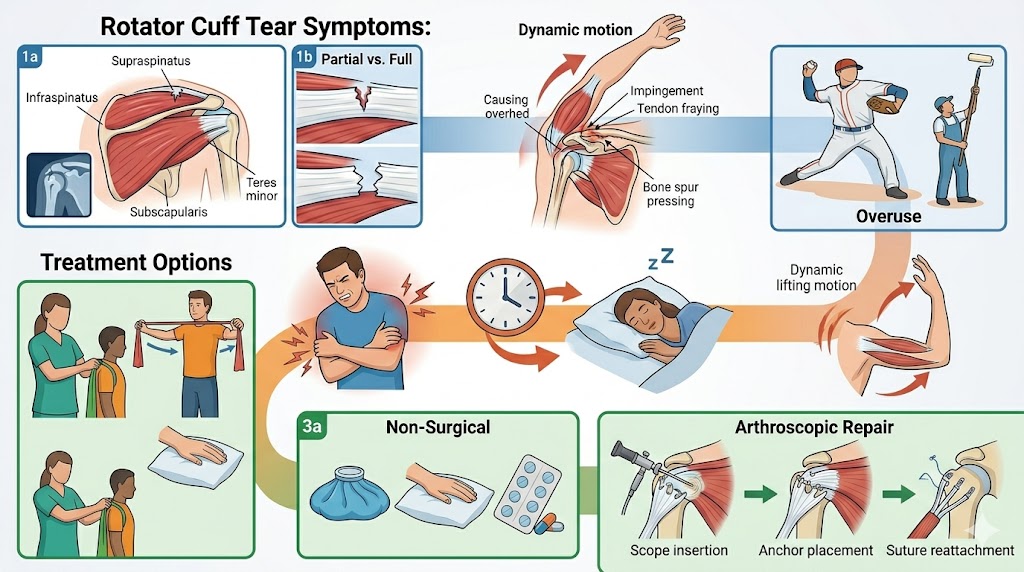
The rotator cuff comprises four distinct muscles, each with a specific location and function. The supraspinatus originates from the supraspinous fossa of the scapula and inserts at the top of the humerus. It initiates arm abduction (lifting the arm out to the side) and is the most commonly injured rotator cuff muscle. The infraspinatus originates from the infraspinous fossa of the scapula and inserts at the posterior (back) aspect of the humeral head. It is the primary external rotator of the shoulder, enabling outward rotation of the arm.

The teres minor is a small muscle that works alongside the infraspinatus for external rotation and also helps compress the humeral head into the glenoid socket. The subscapularis is the largest and strongest of the four muscles, originating from the front face of the scapula and inserting on the lesser tuberosity of the humerus. It is responsible for internal rotation of the arm (turning the arm inward) and is a powerful anterior stabilizer of the shoulder joint.
The Role of the Rotator Cuff Tendons
Each rotator cuff muscle transitions into a tendon before attaching to the humerus. These tendons merge together near their bony insertions to form a continuous tendinous cuff. This tendinous cuff is what is most vulnerable to injury — particularly the supraspinatus tendon, which passes through the subacromial space (a narrow channel beneath the acromion bone) where it is susceptible to impingement and mechanical wear.
Functions of the Shoulder Rotator Cuff
The shoulder rotator cuff performs two primary roles: dynamic stabilization and motion production. As a stabilizer, the rotator cuff compresses the humeral head into the glenoid, preventing the ball from slipping out of the socket during arm movements. Without this dynamic stabilization, the shoulder would be unstable and prone to dislocation. As a motion producer, the four muscles work in coordinated patterns to enable all shoulder movements — lifting, rotating, reaching, throwing, and pushing — while maintaining joint integrity throughout the motion arc.
The rotator cuff also works in close partnership with the larger, more powerful muscles surrounding the shoulder — particularly the deltoid, pectoralis major, and latissimus dorsi. While these larger muscles generate the primary force of movement, the rotator cuff muscles act as fine-tuners and stabilizers, keeping the joint centered and protected throughout every motion.
Common Shoulder Rotator Cuff Injuries
The shoulder rotator cuff is vulnerable to several types of injury. Rotator cuff tendinitis involves inflammation of the tendons, typically caused by repetitive overhead activity or shoulder impingement. It produces aching shoulder pain that worsens with activity. Rotator cuff bursitis is inflammation of the bursa (fluid-filled sac) that lies between the rotator cuff and the acromion, often occurring alongside tendinitis. Rotator cuff strain involves overstretching of the muscle fibers without actual tearing, commonly resulting from sudden or excessive loading.
Rotator cuff tears are the most serious injuries, ranging from partial-thickness tears (where some tendon fibers remain intact) to full-thickness tears (complete rupture of the tendon). Tears can result from acute trauma or long-term degenerative wear. Shoulder impingement syndrome occurs when rotator cuff tendons are repeatedly pinched between the humerus and acromion, causing pain, inflammation, and over time, potential tendon damage.
Risk Factors for Shoulder Rotator Cuff Injury
Several factors increase the risk of rotator cuff injury. Age is the most significant — degenerative changes in the tendons accumulate over time, making people over 40 significantly more vulnerable. Repetitive overhead activities, whether occupational (painters, overhead assembly workers) or athletic (swimmers, baseball pitchers, tennis players), place chronic stress on the rotator cuff. Poor shoulder posture and muscle imbalances that alter shoulder mechanics also contribute to impingement and tendon wear. Previous shoulder injuries and smoking — which impairs blood supply to tendons — are additional risk factors.
Keeping Your Shoulder Rotator Cuff Healthy
Proactive care of the shoulder rotator cuff involves regular strengthening exercises, flexibility work, and movement education. The most effective exercises for rotator cuff health target the external rotators (infraspinatus and teres minor) and the posterior shoulder stabilizers, which are commonly underdeveloped relative to the larger, dominant internal rotators and pressing muscles. Side-lying external rotation, band pull-aparts, face pulls, and prone Y-T-W exercises are particularly valuable. Maintaining good posture — especially avoiding prolonged forward-head and rounded-shoulder positions — reduces chronic mechanical stress on the rotator cuff.
Conclusion
The shoulder rotator cuff is a remarkable biomechanical structure that underpins all shoulder function. Its four muscles and tendons work in seamless coordination to stabilize and move one of the most complex joints in the body. Understanding how this structure works — and how to protect it — is the foundation of shoulder health at every age.