Strained Rotator Cuff: What You Need to Know About Recovery
What Does It Mean to Have a Strained Rotator Cuff?
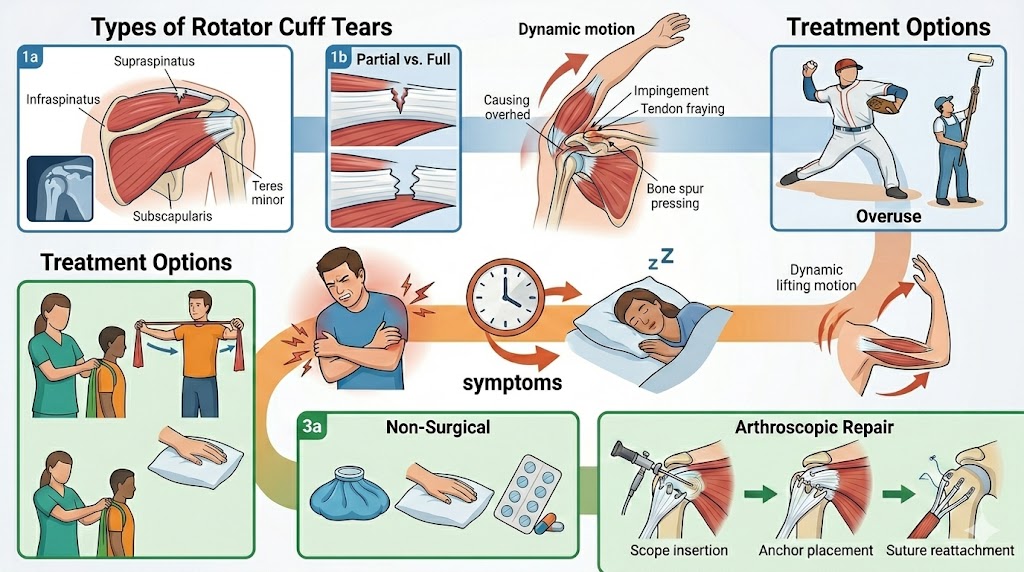
A strained rotator cuff refers to an injury in which one or more of the muscles or tendons of the rotator cuff have been overstretched beyond their normal range, resulting in microscopic or macroscopic damage to the tissue fibers. Unlike a rotator cuff tear, which involves actual tearing or rupture of the tendon, a strain means the tissue has been stressed significantly but has not been completely severed. Think of it as the fibers being partially disrupted rather than cleanly split.
A strained rotator cuff is graded similarly to other soft-tissue strains. A Grade 1 strain involves minor fiber disruption with mild pain and near-normal strength. A Grade 2 strain involves more significant fiber disruption, moderate pain, and noticeable weakness. A Grade 3 strain represents nearly complete disruption of the tissue — essentially the boundary between a severe strain and a partial or full tear — with significant pain and notable functional loss.
How Does a Rotator Cuff Strain Happen?
A strained rotator cuff typically develops through one of two pathways. Acute strains occur suddenly during a specific incident — reaching overhead to catch a falling object, lifting something unexpectedly heavy, throwing with maximum effort, or experiencing a fall that forces the shoulder into an extreme position. The sudden load exceeds the tissue's capacity and results in strain.
Chronic or overuse strains develop progressively. Repetitive overhead activities — whether in sport (swimming, throwing, serving in tennis or volleyball) or work (painting, shelving, overhead assembly) — gradually accumulate microtrauma in the rotator cuff tendons. Without adequate rest and recovery, this microtrauma builds until a clinically significant strain results.
Being fatigued during physical activity is a significant risk factor for acute strains, as tired muscles lose their protective co-contraction ability and tendons are exposed to greater mechanical stress. Poor technique in throwing sports or weightlifting is another common contributing cause.
Signs and Symptoms of a Strained Rotator Cuff
The hallmark symptoms of a strained rotator cuff include pain localized to the outer shoulder or upper arm that worsens with shoulder activity, particularly overhead movements or lifting; mild to moderate weakness when raising the arm, rotating the shoulder outward, or performing functional tasks; tenderness when pressing on the front or outer edge of the shoulder; stiffness and reduced range of motion, especially noticeable after rest; and aching discomfort at night, often intensifying when lying on the injured side.

In Grade 1 strains, pain may be minimal and easily dismissed as "just a sore shoulder," leading many people to delay seeking treatment. This is a mistake — untreated mild strains can worsen with continued activity, potentially progressing to a more serious grade or developing into a chronic tendinopathy.
Diagnosing a Strained Rotator Cuff
Clinical diagnosis begins with a careful history and physical examination. The clinician will test shoulder range of motion, strength in each of the rotator cuff muscle directions, and perform specific provocation tests including the Hawkins-Kennedy, Neer, and Jobe empty-can tests. Pain during these specific maneuvers helps isolate which tendon is involved.
Imaging is typically not required for mild to moderate strains but may be ordered if symptoms are severe, if significant weakness is present, or if progress stalls during conservative treatment. Ultrasound can assess tendon integrity in real time and is readily available. MRI provides the most comprehensive soft-tissue evaluation and is particularly useful if a partial tear is suspected alongside the strain.
Treatment of a Strained Rotator Cuff
The vast majority of strained rotator cuff injuries respond well to conservative treatment when managed appropriately. The PRICE protocol (Protection, Rest, Ice, Compression, Elevation) forms the foundation of initial management. Rest does not mean complete immobilization — gentle, pain-free range-of-motion exercises should begin early to prevent stiffness. Ice applied for 15–20 minutes several times daily reduces acute inflammation in the first 48–72 hours.
Anti-inflammatory medications (NSAIDs such as ibuprofen or naproxen) help control pain and swelling during the acute phase. For persistent or severe inflammation, a corticosteroid injection into the subacromial space can provide meaningful relief and facilitate rehabilitation.
Physical therapy is the cornerstone of recovery from a strained rotator cuff. A structured program typically progresses through three phases: acute phase (pain control, gentle mobility work, scapular stabilization), strengthening phase (progressive resistance training targeting the rotator cuff and shoulder stabilizers), and functional phase (sport- or occupation-specific exercises and return-to-activity training). Consistency in completing the rehabilitation program is the single greatest predictor of successful recovery.
Recovery Timeline
For a Grade 1 strained rotator cuff, most people experience significant improvement within 2–4 weeks and can return to normal activity within 4–6 weeks with appropriate care. Grade 2 strains typically require 6–12 weeks of consistent rehabilitation. More severe strains approaching Grade 3 may need 3–6 months before full function is restored. Premature return to heavy loading or overhead sport is the most common cause of re-injury and prolonged recovery.
Preventing a Strained Rotator Cuff
Prevention focuses on building rotator cuff strength and resilience, ensuring adequate warm-up before activity, using correct technique in throwing and lifting, avoiding sudden dramatic increases in training load, and allowing adequate recovery between sessions. Regular performance of rotator cuff-specific exercises — particularly targeting the external rotators and scapular stabilizers — significantly reduces injury risk in both athletes and working populations.
Conclusion
A strained rotator cuff is a common but manageable injury. With prompt recognition, appropriate initial treatment, and a commitment to structured rehabilitation, the great majority of patients achieve full recovery and return to their previous level of activity. The key is not to ignore early warning signs — shoulder pain that persists beyond a few days warrants professional evaluation to rule out more serious damage and start effective treatment early.