Symptoms of a Torn Rotator Cuff: Warning Signs You Shouldn't Ignore
Why Recognizing the Symptoms of a Torn Rotator Cuff Matters
A torn rotator cuff is one of the most common and potentially debilitating shoulder injuries in both the general population and in athletes. Yet many people dismiss early warning signs as "normal shoulder soreness" and delay seeking care — sometimes for months or even years. This delay can allow a small, easily repairable tear to progress into a massive, irreparable one. Recognizing the specific symptoms of a torn rotator cuff as early as possible is critical for achieving the best possible outcome.
The rotator cuff is a group of four tendons and muscles that surround the shoulder joint, providing both stability and the ability to perform overhead, rotational, and reaching movements. When one or more of these tendons tears — whether from acute trauma or gradual degeneration — the characteristic symptom pattern described below typically follows.
Persistent Shoulder Pain
The most common symptom of a torn rotator cuff is persistent pain in the shoulder, particularly on the outer side or deep within the joint. Unlike the soreness of a simple muscle strain that resolves within days, the pain of a rotator cuff tear tends to linger, often for weeks or months without improvement if the underlying tear is not treated.
The pain is often described as a dull, deep ache rather than a sharp, localized hurt, though acute tears from sudden injury can produce immediate, intense pain at the moment of the event. Activities that provoke the most pain include lifting the arm overhead, reaching behind the back, lifting objects away from the body, and rotating the arm outward.
Nighttime Pain: A Key Diagnostic Clue

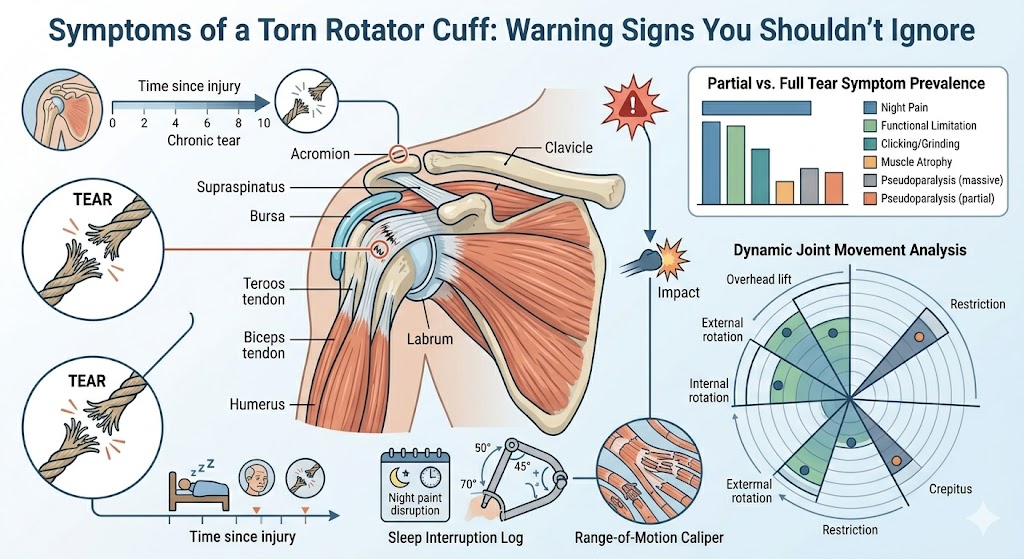
One of the most diagnostically significant symptoms of a torn rotator cuff is pain that is markedly worse at night. Many patients describe being repeatedly awoken from sleep by shoulder discomfort, and lying on the affected side is frequently intolerable. Some patients find that no sleeping position provides relief. This nocturnal pain pattern is thought to result from increased pressure on the torn tendon when the arm is in a relaxed, dependent position and from changes in blood flow that occur during rest.
Nighttime pain that consistently disrupts sleep is one of the clearest signals that a serious rotator cuff problem — beyond simple tendinitis or bursitis — may be present.
Arm Weakness
Weakness in the affected arm is a hallmark symptom of a torn rotator cuff, and the severity of weakness generally reflects the severity of the tear. You may notice difficulty lifting your arm to shoulder height or above; difficulty holding the arm up against any resistance; inability to maintain the arm in a raised position, causing it to drop involuntarily; weakness when trying to rotate the arm outward (such as steering a car or throwing); and functional difficulties with everyday tasks like dressing, grooming, or reaching into overhead storage.
In cases of massive rotator cuff tears, patients may be entirely unable to actively lift the arm above shoulder height despite there being little pain — a phenomenon called "pseudoparalysis." This is a red flag requiring urgent orthopedic evaluation.
Difficulty with Overhead Activities
Among the most functionally limiting symptoms of a torn rotator cuff is the specific difficulty with overhead activities. Reaching for items on high shelves, throwing a ball, hanging laundry, washing hair, and performing overhead press exercises all become painful, weak, or impossible depending on the tear's severity. This limitation directly impacts independence and quality of life, particularly in working individuals and athletes.
Clicking, Catching, and Crepitus
Mechanical sounds or sensations during shoulder movement — including clicking, popping, a catching feeling, or a grinding sensation (crepitus) — are frequently reported alongside a torn rotator cuff. These occur because the torn tendon edges may catch on surrounding structures during movement, or because structural disruption within the joint creates irregular motion. When these sensations are accompanied by pain or weakness, they are particularly significant.
Progressive Muscle Wasting
In longstanding, untreated rotator cuff tears, the muscles attached to the torn tendons can visibly waste away (atrophy). This is most noticeable as hollowing of the areas above or below the shoulder blade. Muscle atrophy indicates that the muscles have lost their normal mechanical function due to the tendon tear and that the injury has been present for an extended period. Significant atrophy is a critical factor in surgical planning, as muscles that have atrophied extensively may not fully recover even after successful tendon repair.
The Difference Between Partial and Full-Thickness Tear Symptoms
Partial-thickness tears (where only part of the tendon is disrupted) often produce pain with specific movements and mild-to-moderate weakness, with preserved but painful function. Full-thickness tears (complete rupture of the tendon) typically cause more severe pain, greater weakness, and more substantial functional loss. However, there is considerable overlap — some partial tears are more symptomatic than some complete tears, particularly in older patients with degenerative tears who have adapted to gradual loss of function.
When to Seek Medical Evaluation
You should seek prompt medical attention if shoulder pain has lasted more than 2–4 weeks without meaningful improvement; if you experience sudden, significant weakness after a shoulder injury; if pain is severe enough to routinely interrupt sleep; or if you notice visible changes in shoulder muscle bulk. An orthopedic specialist can perform clinical tests and order appropriate imaging (ultrasound or MRI) to confirm the diagnosis and guide treatment decisions.
Conclusion
The symptoms of a torn rotator cuff — persistent shoulder pain, night pain, arm weakness, overhead limitations, and mechanical sensations — are distinctive and should not be dismissed as ordinary muscle soreness. Early recognition and appropriate treatment, whether conservative or surgical, provide the best chance of full recovery and return to normal shoulder function. If these symptoms sound familiar, make that appointment — your shoulder will thank you for it.