Chronic Kidney Disease Symptoms: The Complete A-to-Z Guide to Recognizing CKD Warning Signs
Why Chronic Kidney Disease Symptoms Are So Difficult to Detect Early
Chronic kidney disease is frequently called the "silent disease" — and for good reason. In its early stages, CKD produces no symptoms, or symptoms so vague and nonspecific that they are easily attributed to other causes like aging, stress, or a poor night's sleep. This is one of the most dangerous aspects of chronic kidney disease: by the time a person notices something is wrong, significant kidney damage has often already occurred.
The kidneys have tremendous reserve capacity. Even when functioning at just 25–30% of their normal capacity, they may still filter enough waste to prevent obvious symptoms. This adaptive ability is a double-edged sword — while it prevents disability in the early stages, it also means that most people with Stage 1, 2, and even Stage 3 CKD never feel sick. According to the CDC, 90% of people with chronic kidney disease don't know they have it.
Understanding the full spectrum of chronic kidney disease symptoms — from the earliest subtle changes to the unmistakable signs of advanced kidney failure — is essential for patients, their families, and anyone at elevated risk. This guide covers every symptom category comprehensively, explaining the underlying mechanism behind each symptom and what it means for disease progression. To understand the full context of the disease, you may also want to read our complete guide to chronic kidney disease.

Early-Stage CKD Symptoms (Stages 1–3): The Subtle Warning Signs
In the early stages of chronic kidney disease, most people experience no symptoms at all, or only very subtle changes that are easily dismissed. However, certain signs — when noticed — can be important early indicators. Understanding these helps promote earlier diagnosis and treatment, which is critical because slowing CKD progression is most effective when started early.
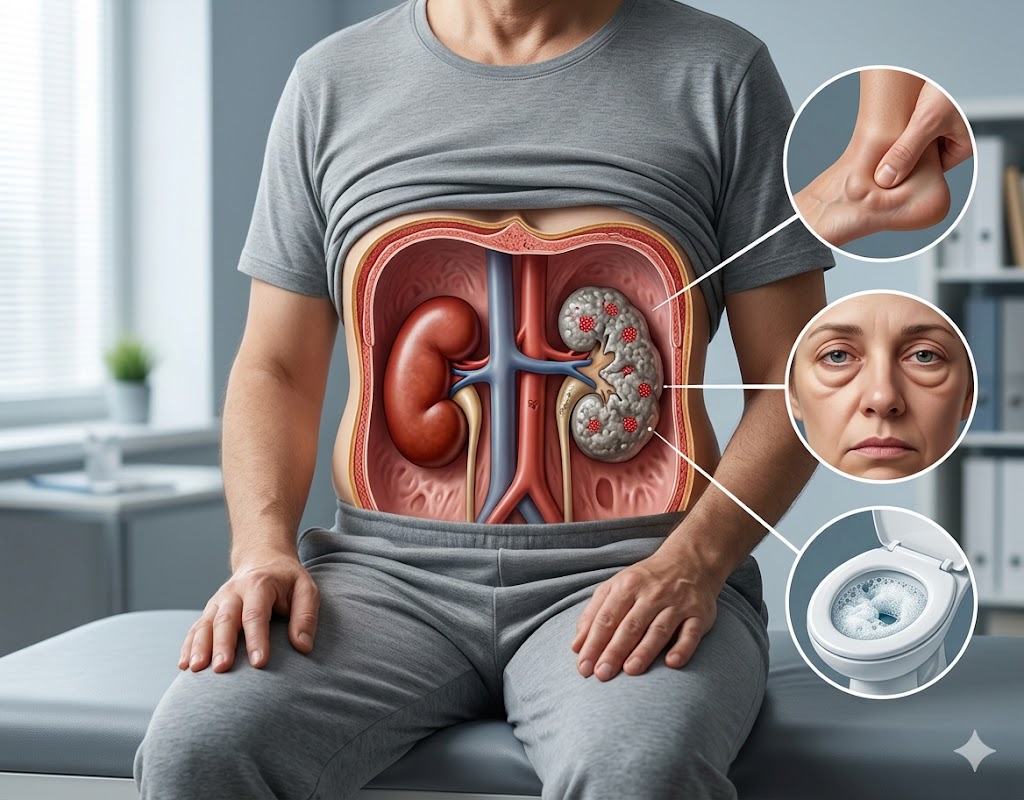
Changes in urination patterns are among the first and most telling symptoms of CKD. You may notice that you are urinating more frequently, particularly at night (a symptom called nocturia). Healthy kidneys concentrate urine during sleep, but damaged kidneys lose this ability, producing more dilute urine more frequently. Conversely, some people urinate less than usual, which can also signal kidney impairment. Foamy or bubbly urine is a particularly significant early sign — this indicates the presence of protein (albuminuria), which is leaking into the urine because the kidney's filters have been damaged. Frothy urine that looks like bubbles that persist after flushing should prompt a visit to a doctor for a urine protein test.
Pale or dark-colored urine changes can also be informative. Dark brown or cola-colored urine may indicate blood in the urine (hematuria) — either visible to the naked eye or microscopic (detectable only on urinalysis). Blood in the urine occurs when damaged glomeruli allow red blood cells to pass through into the urine. While not always present, this symptom, when found, warrants immediate medical evaluation to determine its cause — which may be CKD, kidney stones, infection, or other conditions.
Mild swelling, particularly around the eyes in the morning or in the feet and ankles by the end of the day, can be an early symptom of kidney disease. This edema occurs because damaged kidneys cannot properly regulate fluid and sodium balance, leading to fluid retention in the tissues. Many people dismiss mild puffiness around the eyes as the result of a late night or excess sodium intake, but persistent puffiness — particularly in the morning — is worth investigating.
Persistent fatigue and reduced energy levels are among the most common early CKD symptoms, though they are also among the most non-specific. As kidney function declines, the kidneys produce less erythropoietin (EPO), the hormone that stimulates the bone marrow to produce red blood cells. Reduced EPO leads to anemia, and anemia causes fatigue, weakness, and reduced stamina. Additionally, a mild accumulation of waste products in the blood — even at levels not yet causing obvious symptoms — can impair metabolism and contribute to fatigue.
Urinary Symptoms in Chronic Kidney Disease: A Detailed Overview
The kidneys play the central role in producing urine, so it is not surprising that many CKD symptoms relate directly to urination. Paying attention to changes in urine characteristics — frequency, volume, color, clarity, and odor — can provide valuable diagnostic clues.
Oliguria refers to significantly reduced urine output (less than 400 mL per day in adults), while anuria (essentially no urine output) represents complete kidney shutdown. These are signs of severe kidney impairment and constitute medical emergencies. More commonly in CKD, patients experience polyuria (increased urine output), especially in tubular disorders where the kidney's ability to concentrate urine is compromised before GFR falls significantly. In diabetic nephropathy, early disease is often characterized by increased urine output.
Dysuria — pain or burning during urination — is more commonly associated with urinary tract infections or kidney stones than with CKD per se, but recurrent UTIs or kidney stones can contribute to kidney damage over time, making this an indirect symptom of relevance. Urgency and incomplete bladder emptying may occur in CKD patients due to associated neurological changes or obstructive causes of kidney disease.
The presence of protein in the urine (proteinuria or albuminuria) is one of the most important biochemical markers of kidney damage, even before symptoms develop. While not always visible to the patient, severe proteinuria can cause frothy urine. Proteinuria is measured through urine tests and its severity correlates with CKD stage and risk of progression — heavy proteinuria accelerates kidney damage and cardiovascular risk significantly.
Systemic Symptoms: What Happens When Kidneys Can't Filter Waste
As CKD advances into Stage 3 and beyond, the accumulation of waste products and metabolic imbalances begin to produce systemic symptoms that affect virtually every organ system in the body. The syndrome caused by the retention of uremic toxins is called uremia, and its symptoms are wide-ranging and often severe.
Nausea and vomiting are among the most characteristic symptoms of worsening CKD. Uremic toxins, particularly urea and other nitrogen-containing compounds, irritate the gastrointestinal tract. Patients may experience chronic nausea, particularly in the morning, loss of appetite (anorexia), and episodic vomiting. This can contribute to significant weight loss and malnutrition, which in turn worsen the overall clinical picture. The smell of ammonia on the breath (uremic fetor) occurs because bacteria in the mouth break down the elevated urea in saliva — this is a hallmark finding in severe CKD or kidney failure.
Metallic taste in the mouth is another common complaint related to uremia. This altered taste — sometimes described as bitter, metallic, or "off" — can significantly reduce appetite and food enjoyment. Many CKD patients notice they lose interest in meat, which happens to also reduce protein intake and can paradoxically be somewhat protective. The mechanism involves uremic compounds altering taste receptor sensitivity and salivary composition.
Hiccups — seemingly trivial — can be a persistent and distressing symptom of uremia. When uremic toxins accumulate, they can irritate the phrenic nerve and the diaphragm, triggering persistent, treatment-resistant hiccuping. This symptom often resolves once dialysis clears the uremic toxins from the blood.

Neurological and Cognitive Symptoms of CKD
Chronic kidney disease profoundly affects the nervous system through multiple mechanisms. Uremic toxins impair neurotransmitter function, anemia reduces oxygen delivery to the brain, electrolyte imbalances disrupt neural signaling, and hypertension damages cerebral blood vessels. The result is a broad spectrum of neurological and cognitive symptoms that significantly impair quality of life.
Cognitive impairment — often described by patients as "brain fog," difficulty concentrating, or memory problems — is extremely common in CKD, affecting up to 40% of patients with advanced disease. Many patients struggle to follow conversations, remember appointments, or complete tasks they previously managed easily. This cognitive impairment results from uremic encephalopathy (the effect of toxins on brain function), reduced cerebral blood flow from cardiovascular disease, sleep disturbances, and anemia. Detecting and treating CKD-related cognitive impairment is important, as it significantly impacts medication adherence and disease self-management.
Peripheral neuropathy — numbness, tingling, or burning sensations in the hands and feet — develops in many patients with advanced CKD. Uremic toxins damage peripheral nerves, and the classic pattern is a "glove-and-stocking" distribution affecting the extremities symmetrically. Patients may notice they cannot feel their feet properly, stumble when walking, or experience painful burning sensations at night. Uremic neuropathy can progress to motor weakness if not treated (typically with dialysis).
Restless legs syndrome (RLS) — an overwhelming urge to move the legs, usually at night, associated with uncomfortable sensations — affects approximately 25–30% of dialysis patients and a significant proportion of pre-dialysis CKD patients. RLS severely disrupts sleep, contributing to insomnia, daytime fatigue, and reduced quality of life. The mechanism in CKD involves iron deficiency, uremic toxin effects on dopamine receptors, and peripheral nerve dysfunction.
Muscle cramps, particularly nocturnal leg cramps, are very common in CKD. These are caused by electrolyte imbalances (low calcium, low sodium, or altered potassium levels) and uremic effects on muscle metabolism. Cramps can be severe and disabling, waking patients from sleep repeatedly.
Cardiovascular and Respiratory Symptoms in CKD
The relationship between CKD and cardiovascular disease is inseparable — both cause and perpetuate each other. Cardiovascular symptoms are among the most important and dangerous manifestations of advanced CKD, and represent the leading cause of death in this patient population.
Shortness of breath (dyspnea) in CKD has multiple causes. Fluid overload — resulting from impaired sodium and water excretion — can cause pulmonary edema (fluid in the lungs), manifesting as breathlessness, particularly when lying flat (orthopnea) or waking from sleep with sudden breathlessness (paroxysmal nocturnal dyspnea). Anemia reduces the blood's oxygen-carrying capacity, causing breathlessness with even mild exertion. Uremic pleuritis (inflammation of the lung lining) and pericarditis (inflammation of the heart sac) can also cause chest discomfort and breathing difficulty.
Chest pain in CKD may result from uremic pericarditis — a characteristic complication of advanced uremia in which uremic toxins inflame the pericardium (the fibrous sac surrounding the heart). Classic uremic pericarditis causes a sharp, positional chest pain that worsens when lying flat and improves when leaning forward. The pain may be accompanied by a pericardial friction rub audible with a stethoscope. This is a serious finding that typically indicates the need for urgent dialysis initiation.
Hypertension — high blood pressure — is both a cause and a consequence of CKD, creating a vicious cycle. The kidneys play the central role in long-term blood pressure regulation, and damaged kidneys retain sodium and water, activate the renin-angiotensin system inappropriately, and produce vasoconstricting substances. Persistent, difficult-to-control hypertension should always prompt evaluation of kidney function.
Skin, Hair, and Nail Symptoms of Kidney Disease
Kidney disease manifests visibly in the skin, hair, and nails — changes that can be important clues to the diagnosis and severity of CKD.
Pruritus — generalized itching — is one of the most distressing and most common symptoms of advanced CKD, affecting up to 40% of Stage 5 patients. This kidney disease itch (also called uremic pruritus or chronic kidney disease-associated pruritus) is not fully understood but involves deposition of calcium-phosphate crystals in the skin, elevated parathyroid hormone levels, increased skin mast cells, and uremic toxin effects on cutaneous nerve fibers. The itch tends to be worst at night, is not relieved by antihistamines, and can be severe enough to cause significant skin damage from scratching, insomnia, and depression.
Pallor — pale skin and mucous membranes — results from CKD-related anemia. The skin may take on a yellowish hue (urochrome pigmentation) due to deposition of urinary pigments that cannot be excreted. In severe uremia, patients may develop a grayish-yellow complexion called uremic pallor. These are signs of advanced disease. Bruising easily and prolonged bleeding after minor cuts can occur due to platelet dysfunction in uremia — the uremic toxins impair normal platelet aggregation, leading to a bleeding tendency despite normal platelet counts.
Dry, flaky skin is extremely common in CKD, resulting from reduced activity of sweat glands, altered skin lipid composition, and elevated calcium-phosphate products. "Uremic frost" — a white crystalline deposit on the skin from urea crystallization in sweat — is a classic but now rarely seen sign of very severe uremia, as dialysis is typically initiated before this stage is reached.
Terry's nails (white nails with a dark band at the tip) and half-and-half nails (proximal white, distal brownish-red — also called Lindsay's nails) are nail findings classically associated with chronic kidney disease. Clubbing — bulbous enlargement of fingertips — may occur in advanced CKD. These changes reflect the systemic metabolic derangements of kidney failure affecting nail matrix cell growth.

Metabolic and Endocrine Symptoms of Chronic Kidney Disease
The kidneys are not merely filters — they are endocrine organs that produce and regulate hormones and play a central role in mineral metabolism. When kidney function declines, these endocrine and metabolic functions are disrupted, producing a cascade of symptoms.
Bone pain and fractures occur in CKD due to a complex disorder of bone metabolism called renal osteodystrophy (now more broadly termed chronic kidney disease-mineral and bone disorder, or CKD-MBD). Damaged kidneys cannot activate vitamin D, which is essential for calcium absorption. The resulting low calcium and high phosphate levels trigger secondary hyperparathyroidism — the parathyroid glands compensate by secreting excessive PTH, which mobilizes calcium from bones. Over years, this leads to bone loss, bone pain, deformity, and increased fracture risk. Patients may describe deep, aching bone pain in the hips, knees, or lower back.
Sexual dysfunction is common in both male and female CKD patients. In men, erectile dysfunction and reduced libido result from hormonal changes (reduced testosterone), vascular disease, uremic effects on nerve function, anemia, and psychological factors including depression and anxiety. In women, menstrual irregularities — including amenorrhea (absence of periods) — are common in advanced CKD due to disruption of the hypothalamic-pituitary-gonadal axis by uremic toxins. Both sexes may experience reduced fertility, which has profound quality-of-life implications.
Metabolic acidosis — the accumulation of acid in the blood — develops as the kidneys lose their ability to excrete the daily acid load produced by metabolism. Acidosis contributes to muscle wasting (catabolism), bone loss (as bone buffers the excess acid), impaired insulin signaling, and progression of kidney disease itself. Patients may experience deeper and more rapid breathing (Kussmaul respiration) as the respiratory system compensates for the acidosis.
Advanced CKD Symptoms: Signs That Dialysis May Be Needed
As CKD progresses toward Stage 5 (end-stage kidney disease), the constellation of symptoms becomes overwhelming. Recognizing these advanced symptoms is critical for timely initiation of renal replacement therapy, as delay increases mortality risk. Our article on chronic renal failure covers this stage in comprehensive detail.
Severe fluid overload manifesting as marked edema throughout the body (anasarca), breathlessness at rest, reduced exercise tolerance, and hypertension that is difficult to control all indicate the kidneys can no longer maintain fluid balance. Patients may gain 5–10 kg of fluid weight over days to weeks. In extreme cases, fluid accumulates in the abdomen (ascites) or around the lungs (pleural effusion), causing severe respiratory distress.
Uremic syndrome — the collective term for the severe constellation of symptoms from toxin accumulation — includes severe nausea and vomiting, inability to eat, profound fatigue and weakness, altered consciousness or confusion, asterixis (a "flapping tremor" when outstretching the arms, characteristic of metabolic encephalopathy), and eventually, if untreated, coma and death. The development of uremic encephalopathy (confusion, seizures, or coma) is a medical emergency indicating immediate need for dialysis.
For a comprehensive discussion of the early warning signs of CKD that can prompt earlier medical evaluation, see our dedicated guide. And if you want to understand the diagnostic and staging framework for CKD, our article on CKD stages, diagnosis, and management provides detailed information.

When to See a Doctor: Red Flags in Kidney Disease
While many CKD symptoms are subtle, certain signs should prompt immediate or urgent medical evaluation. Blood in the urine (hematuria) — whether visible or detected on a dipstick test — always requires investigation. Sudden significant swelling in the legs, feet, or face, particularly if rapid in onset, warrants same-day evaluation. Severe shortness of breath, chest pain, or altered consciousness in someone with known kidney disease requires emergency care.
For people in high-risk groups — those with diabetes, hypertension, a family history of kidney disease, or previous kidney problems — annual kidney function testing (eGFR and urine albumin) is recommended even in the absence of symptoms. Early detection, before symptoms develop, is the most powerful tool for changing the course of CKD and preventing progression to kidney failure.
If you have been experiencing several of the symptoms described in this guide — persistent fatigue, changes in urination, swelling, or high blood pressure that is difficult to control — speak to your healthcare provider about kidney function testing. Understanding your symptoms in the broader context of CKD risk and progression can be life-changing. Review our comprehensive resource on chronic kidney disease for a complete overview of the disease, its causes, and the full range of treatment options available.