CKD Symptoms: 15 Early Warning Signs of Chronic Kidney Disease You Should Never Ignore
Why CKD Symptoms Are Often the Last to Appear
When people think about kidney disease, they often imagine obvious, dramatic symptoms. The reality is quite different. CKD (chronic kidney disease) is notorious for developing silently over years — and in many patients, the first "symptom" is a blood test result showing elevated creatinine or reduced eGFR, discovered during a routine check-up for an entirely different reason. The sobering statistic: up to 90% of people with early to mid-stage CKD are completely unaware they have it.
This happens because the kidneys have enormous functional reserve. Even when 50–60% of nephrons (the functional filtering units) are damaged or destroyed, the remaining healthy nephrons increase their workload to compensate — a process called adaptive hyperfiltration. Total kidney function appears adequate on standard blood tests until roughly 40–50% of normal capacity remains. This is why early-stage CKD symptoms, when they do occur, are often vague, non-specific, and easily attributed to other conditions.
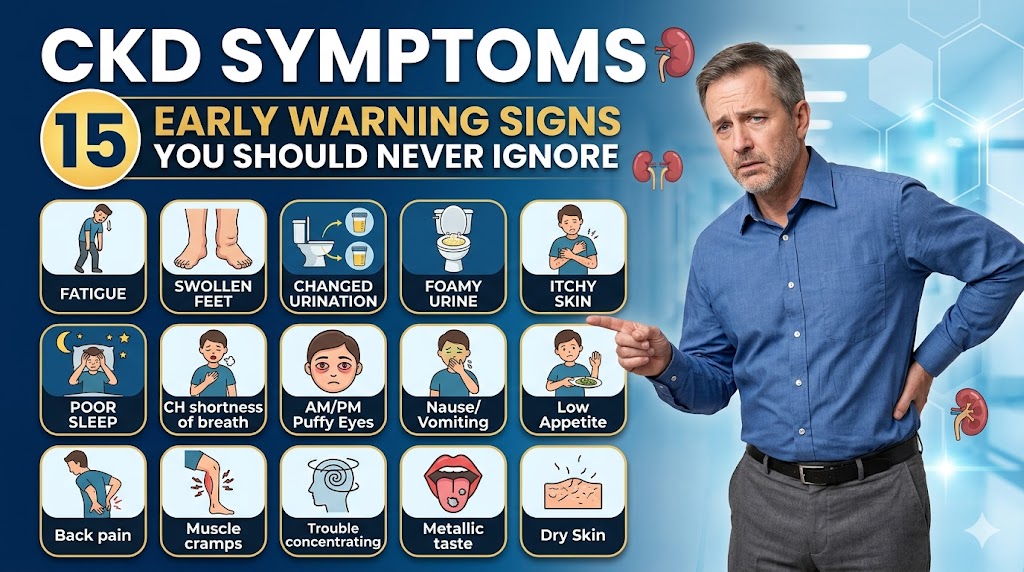
However, there are subtle early warning signs that, when recognized, can lead to earlier diagnosis and more effective treatment. This guide explores 15 CKD symptoms, organized from the earliest and most subtle to the more obvious signs of advancing disease. For a broader understanding of CKD and how it develops, see our complete guide to chronic kidney disease. For a deeper exploration of the full symptom spectrum across all disease stages, our article on chronic kidney disease symptoms provides comprehensive clinical detail.
Early Warning Sign #1: Changes in Urination Frequency and Appearance
The kidneys produce urine, so it's not surprising that changes in urination are often among the earliest CKD warning signs. The challenge is that these changes are often subtle and inconsistent, making them easy to dismiss.
Increased urination frequency, especially at night (nocturia), is one of the earliest kidney function changes. Healthy kidneys concentrate urine during sleep to reduce the need for nighttime trips to the bathroom. Damaged kidneys lose this concentrating ability early, resulting in more dilute urine being produced throughout the day and night. Many people assume waking up once or twice nightly to urinate is normal aging — and it may be — but if this is new or worsening, kidney function is worth checking.
Foamy or persistently bubbly urine is a particularly significant early sign. If your urine looks like the surface of a cappuccino — frothy, with bubbles that persist after flushing — this suggests protein (specifically albumin) is leaking into the urine because the kidney's filtering membrane has been damaged. Normal urine contains essentially no protein. Even trace amounts of albumin in the urine (detectable only on laboratory testing, not visible) double or triple the risk of CKD progression.
Dark brown, tea-colored, or cola-colored urine may indicate blood in the urine (hematuria). The kidneys' damaged filters can allow red blood cells to pass through into the urine, giving it a rusty or brownish color. While sometimes visible, blood in the urine is more often microscopic — only detectable on urinalysis. Any visible blood in the urine warrants immediate medical evaluation to identify the cause.
Early Warning Sign #2: Unexplained Fatigue and Weakness
Fatigue is one of the most universal CKD symptoms and often develops well before kidney disease is formally diagnosed. The problem is that fatigue is incredibly non-specific — it can be caused by hundreds of conditions, poor sleep, stress, or simply a demanding lifestyle. This makes it one of the most commonly dismissed early warning signs.
In CKD, fatigue stems from multiple intersecting mechanisms. The most important is anemia, which develops as the kidneys produce progressively less erythropoietin (EPO), the hormone that stimulates bone marrow to produce red blood cells. Without sufficient EPO, red blood cell production falls and hemoglobin levels drop. Less hemoglobin means less oxygen delivery to muscles and tissues, resulting in fatigue, weakness, and reduced exercise tolerance.
Even before anemia develops, a mild accumulation of metabolic waste products in the blood impairs cellular energy metabolism at the mitochondrial level, contributing to fatigue. Patients often describe a quality of tiredness that feels different from ordinary tiredness — deeper, heavier, and not relieved by sleep. Activities that were previously effortless — climbing stairs, walking the dog, carrying groceries — become increasingly challenging. If you are experiencing persistent, unexplained fatigue and have risk factors for CKD (diabetes, hypertension, family history), asking your doctor to check your kidney function is entirely reasonable.
Early Warning Sign #3: Swelling in the Face, Hands, Feet, or Ankles
Edema — swelling caused by fluid accumulation in the tissues — is a classic CKD symptom, though it tends to become more prominent in the intermediate and advanced stages. The earliest manifestation is often puffiness around the eyes in the morning (periorbital edema), which may be noticed as looking "puffy-faced" or "having bags under the eyes" upon waking. This occurs because when lying down, the fluid redistributes toward the face.
Swelling in the feet and ankles typically develops later and worsens over the course of the day (due to gravity). Patients may notice their shoes feel tight by the afternoon, or that pressing a finger into the ankle leaves an indentation (called pitting edema). Rings may feel tight on the fingers. The swelling is caused by two mechanisms: sodium and water retention (as the damaged kidneys cannot excrete enough sodium and fluid) and reduced albumin production (as the liver makes less albumin when it senses protein loss through the kidneys, reducing the blood's capacity to hold fluid within vessels).
It is important to note that not all swelling indicates kidney disease — heart failure, liver disease, venous insufficiency, and even standing for long periods can cause edema. However, swelling that is persistent, generalized (affecting multiple body areas), or accompanied by other symptoms like changes in urination or blood pressure changes should prompt medical evaluation.
Early Warning Sign #4: Persistent Itching (Pruritus)
While itching without rash tends to become more prominent in advanced CKD, some patients experience it in moderate stages as well, and it is a distinctly kidney-related symptom that is poorly understood by many patients and even some clinicians.
Uremic pruritus — the generalized, often severe itching of kidney disease — occurs because damaged kidneys cannot adequately excrete certain toxins, which accumulate and affect the skin and peripheral nerves. Elevated phosphorus levels (from impaired kidney phosphate excretion) lead to calcium-phosphate crystal deposits in the skin. Elevated parathyroid hormone further contributes by increasing skin mast cells that release itch-causing histamine. Dry skin — common in CKD due to reduced sweat and sebaceous gland activity — worsens the sensation.
The itch of CKD is characteristically different from ordinary itching: it tends to affect large body areas (often the back, arms, and legs), is worst at night, is poorly responsive to antihistamines, and can be intensely distressing. Patients often have excoriation marks (scratch marks) on their skin. If you have known risk factors for CKD and experience persistent, unexplained itching — particularly of this character — it is worth discussing kidney function testing with your doctor.

Early Warning Sign #5: Shortness of Breath
Unexplained breathlessness — particularly with mild exertion or at rest — can be an important CKD symptom, though it is often attributed to other causes including heart disease, lung disease, obesity, or deconditioning. In CKD, dyspnea (shortness of breath) can result from several mechanisms.
Anemia-related reduced oxygen delivery to tissues means the cardiovascular and respiratory systems must work harder to compensate — resulting in faster breathing and breathlessness with lower levels of activity than previously. Fluid overload from impaired renal sodium and water excretion can cause fluid to accumulate in the lungs (pulmonary edema), causing breathlessness that is worse when lying flat (orthopnea) and may wake patients from sleep. Metabolic acidosis — the buildup of acid in the blood as the kidneys fail to excrete the daily acid load — triggers compensatory faster and deeper breathing (Kussmaul breathing) as the respiratory system attempts to reduce blood acidity by blowing off carbon dioxide.
Breathlessness that is new or worsening, particularly if combined with swelling or changes in urine, should always prompt medical evaluation. In the context of known or suspected CKD, it may indicate disease progression to a stage where urgent intervention is needed.
Early Warning Sign #6: Brain Fog and Difficulty Concentrating
Cognitive changes — difficulty concentrating, memory problems, slowed thinking, and what patients often describe as "brain fog" — are common CKD symptoms that affect quality of life substantially but are rarely recognized as potentially kidney-related. These symptoms are particularly challenging because they are non-specific and tend to develop gradually.
In CKD, multiple mechanisms impair brain function. Uremic toxins — the metabolic waste products that accumulate as the kidneys fail — cross the blood-brain barrier and impair neurotransmitter synthesis and function, reduce synaptic plasticity, and cause subtle inflammation throughout the brain. Anemia reduces oxygen delivery to the brain, impairing cognitive function similarly to high-altitude exposure. Hypertension — common in CKD — damages small cerebral blood vessels, reducing cerebral blood flow and increasing the risk of white matter lesions (small areas of brain damage that impair cognitive function). Sleep disturbances — extremely common in CKD, including insomnia and sleep apnea — compound the cognitive impairment.
Patients and families should not dismiss new or worsening cognitive difficulties in middle-aged or older adults who have risk factors for CKD. While dementia and other neurological conditions must be considered, kidney disease is a treatable contributor to cognitive decline that should be routinely evaluated.
Early Warning Sign #7: High Blood Pressure That Is Hard to Control
Hypertension (high blood pressure) is both a leading cause and a common consequence of CKD — the relationship between the two is bidirectional and self-reinforcing. Damaged kidneys have impaired ability to regulate blood pressure through sodium and water excretion and through the renin-angiotensin-aldosterone system. As a result, blood pressure tends to rise as kidney function declines.
The insidious aspect of this relationship is that hypertension causes further kidney damage, accelerating CKD progression — which in turn worsens hypertension further. This vicious cycle is one of the reasons that blood pressure control is so critical in CKD management. New-onset hypertension, hypertension that was previously controlled but has become difficult to manage, or hypertension that requires multiple medications should always prompt evaluation of kidney function — particularly in people under 50, where primary hypertension is less common and secondary causes (including renal artery disease and kidney parenchymal disease) are more frequently identified.
Early Warning Sign #8: Nausea, Vomiting, and Loss of Appetite
While nausea and vomiting are prominent features of advanced uremia (end-stage kidney disease), subtler versions of these symptoms can occur in intermediate stages of CKD as uremic toxin levels begin to accumulate. Patients in Stage 3–4 CKD may notice a gradual loss of appetite, particularly for protein-rich foods like meat, without a clear explanation.
The gastrointestinal symptoms of CKD result from uremic toxin effects on the enteric nervous system and gut lining, altered gut microbiome composition (which is dramatically disrupted in CKD), and elevated urea levels in gastrointestinal secretions. Some patients describe a persistent feeling of nausea, particularly in the morning, similar to pregnancy-related morning sickness. A metallic or bitter taste in the mouth is another early gastrointestinal-related symptom of CKD that patients often mention, which results from uremic compounds altering taste receptor sensitivity.
If you have persistent unexplained nausea, loss of appetite (particularly for meat), or a persistent metallic taste — and you have risk factors for CKD — it is worth requesting kidney function testing from your doctor. These symptoms, combined with other warning signs, may indicate CKD that has gone undiagnosed.
Early Warning Sign #9: Muscle Cramps
Muscle cramps — particularly nocturnal leg cramps that wake you from sleep — are a common and distressing symptom of CKD, especially in stages 3–5. These cramps result primarily from electrolyte imbalances: low calcium, altered magnesium levels, and in some cases, sodium or potassium fluctuations, all of which affect muscle membrane excitability and contraction-relaxation cycles.
CKD progressively impairs electrolyte regulation as the number of functioning nephrons decreases. The kidneys normally fine-tune blood levels of calcium, phosphate, magnesium, and potassium with extraordinary precision. As this regulatory capacity fails, electrolyte imbalances emerge that trigger abnormal muscle activity, including cramps and fasciculations (visible muscle twitching under the skin). Uremic toxins additionally affect muscle cell metabolism and membrane function, contributing to cramp susceptibility.

Early Warning Sign #10: Persistent Back or Flank Pain
Pain in the lower back or flank (the area just below the ribs on either side of the spine) is not a universal CKD symptom, but it is associated with certain types of kidney disease. Polycystic kidney disease (PKD) — the most common hereditary kidney disease — characteristically causes flank pain as the cysts grow and enlarge the kidneys, sometimes dramatically. Kidney infections (pyelonephritis) cause severe flank pain with fever and require urgent treatment, as repeated infections contribute to kidney scarring and CKD.
Kidney stones, which are both a risk factor for CKD and a consequence of some metabolic CKD complications, cause excruciating flank pain that radiates to the groin when stones pass through the ureter. Unlike the dull ache of PKD or kidney infections, kidney stone pain (renal colic) is typically severe, colicky, and associated with nausea and vomiting. Recurrent kidney stones should prompt evaluation for metabolic causes and for any resulting kidney damage.
It is important to note that most CKD — including the common forms caused by diabetes and hypertension — does not cause back pain. The kidneys do not have pain receptors in their parenchyma (filtering tissue), so gradual deterioration from these causes is painless. Pain-related CKD warning signs are therefore specific to certain underlying conditions rather than being universal.
Early Warning Signs #11–15: Additional Symptoms to Watch For
Beyond the ten major symptoms above, several additional warning signs of CKD deserve mention. Anemia-related symptoms beyond fatigue include pallor (pale skin and conjunctivae), increased sensitivity to cold, dizziness upon standing (orthostatic hypotension), and rapid heartbeat (palpitations). These symptoms reflect the cardiovascular strain of reduced oxygen-carrying capacity and often prompt blood count testing that reveals anemia, leading to further investigation of the cause — including kidney function testing.
Restless legs syndrome (RLS) — the irresistible urge to move the legs, particularly at night, associated with uncomfortable creeping or tingling sensations — affects a significant proportion of CKD patients and is much more prevalent in this population than in the general public. While RLS has multiple causes, its presence in someone with risk factors for CKD warrants kidney function evaluation. Persistent hiccups are a classical, if unusual, CKD symptom resulting from irritation of the phrenic nerve and diaphragm by uremic toxins. While occasionally harmless, persistent hiccups lasting more than 48 hours should prompt medical evaluation, particularly in someone with CKD risk factors.
Changes in skin color and texture — including yellowish or grayish skin tone (from urochrome pigmentation), excessive dryness, bruising easily, and a tendency to bleed from minor cuts — are signs of advanced CKD rather than early disease, but they can be the first obvious external sign of kidney failure in patients who have not had regular medical testing. Metallic taste and loss of appetite have already been mentioned, but persistent weight loss without explanation in the context of reduced appetite should be evaluated — this combination in someone with risk factors may indicate advancing CKD with protein-energy malnutrition, a serious complication.
Who Is Most at Risk and Should Be Screened for CKD?
Given how often CKD develops silently, proactive screening of high-risk individuals is the most powerful tool for early detection. The populations with the highest CKD risk include people with type 1 or type 2 diabetes (annual kidney function testing is recommended for all diabetics), people with hypertension (tested at least every 1–2 years), people over 60 years old (kidney function declines with age), and people with a first-degree relative (parent, sibling, child) with kidney disease or kidney failure.
Additional high-risk groups include people with cardiovascular disease, obesity, recurrent kidney stones, chronic NSAID or analgesic use, certain autoimmune diseases (lupus, vasculitis, IgA nephropathy), and people of Black or African American, Hispanic/Latino, or Native American ethnicity (who face disproportionately high rates of CKD, largely reflecting higher rates of diabetes and hypertension in these communities). Screening involves two tests: an eGFR blood test (calculated from serum creatinine) and a urine albumin-to-creatinine ratio (uACR). These simple, inexpensive tests can detect CKD years before symptoms develop.
What to Do If You Recognize CKD Symptoms
If you are experiencing one or more of the symptoms described in this article — particularly if you have known risk factors for CKD — the most important step is to speak with your primary care physician or nephrologist. Be specific about your symptoms: describe when they started, how they have changed over time, and any other health conditions you have. Ask explicitly for kidney function testing, including serum creatinine, eGFR, and urine albumin-to-creatinine ratio.
Early diagnosis is genuinely transformative in CKD. Patients diagnosed in Stage 1–2 who receive appropriate treatment — blood pressure control, blood sugar management (if diabetic), use of nephroprotective medications, dietary modifications, and lifestyle changes — have a dramatically different prognosis than those diagnosed in Stage 4–5. Many early-stage CKD patients can maintain adequate kidney function for decades with proper management and never need dialysis or transplantation.
For a comprehensive overview of the diagnostic workup and management strategies at each stage of CKD, our guide on CKD stages, diagnosis, and management is an excellent resource. If you have progressed to a point where kidney failure is being discussed, our article on chronic renal failure and its treatment options provides detailed, accurate information about dialysis, transplantation, and conservative care.

Frequently Asked Questions About CKD Symptoms
Can you have CKD with no symptoms? Absolutely — this is the most common situation. The majority of people with CKD Stages 1–3 experience no symptoms whatsoever, or only very subtle changes they attribute to other causes. This is why screening high-risk individuals with simple blood and urine tests is so important.
What does CKD pain feel like? Most forms of CKD — particularly diabetic and hypertensive nephropathy — cause no pain. Kidney pain (flank pain) is associated with specific conditions like polycystic kidney disease, kidney infections, and kidney stones rather than with CKD in general. The absence of pain does not mean the kidneys are healthy.
How quickly do CKD symptoms develop? CKD symptoms typically develop very gradually over months to years, in parallel with the slow decline in kidney function. The speed varies enormously depending on the underlying cause, how well risk factors are controlled, and individual patient factors. Some patients remain essentially asymptomatic until Stage 4–5; others develop symptoms earlier.
At what stage of CKD do symptoms appear? Most clinically significant symptoms begin to emerge in Stage 3b–4, when eGFR drops below 30–44 mL/min. However, changes in urination, fatigue, and blood pressure may be subtle early indicators in Stage 2–3a. By Stage 5, the full uremic syndrome is typically present.
What should I do if I think I have CKD? See your doctor and request a kidney function check: serum creatinine/eGFR and a spot urine albumin-to-creatinine ratio. These simple tests are the foundation of CKD diagnosis and can detect it at an early, treatable stage. Don't wait for symptoms to become severe — by then, significant irreversible damage has often already occurred